
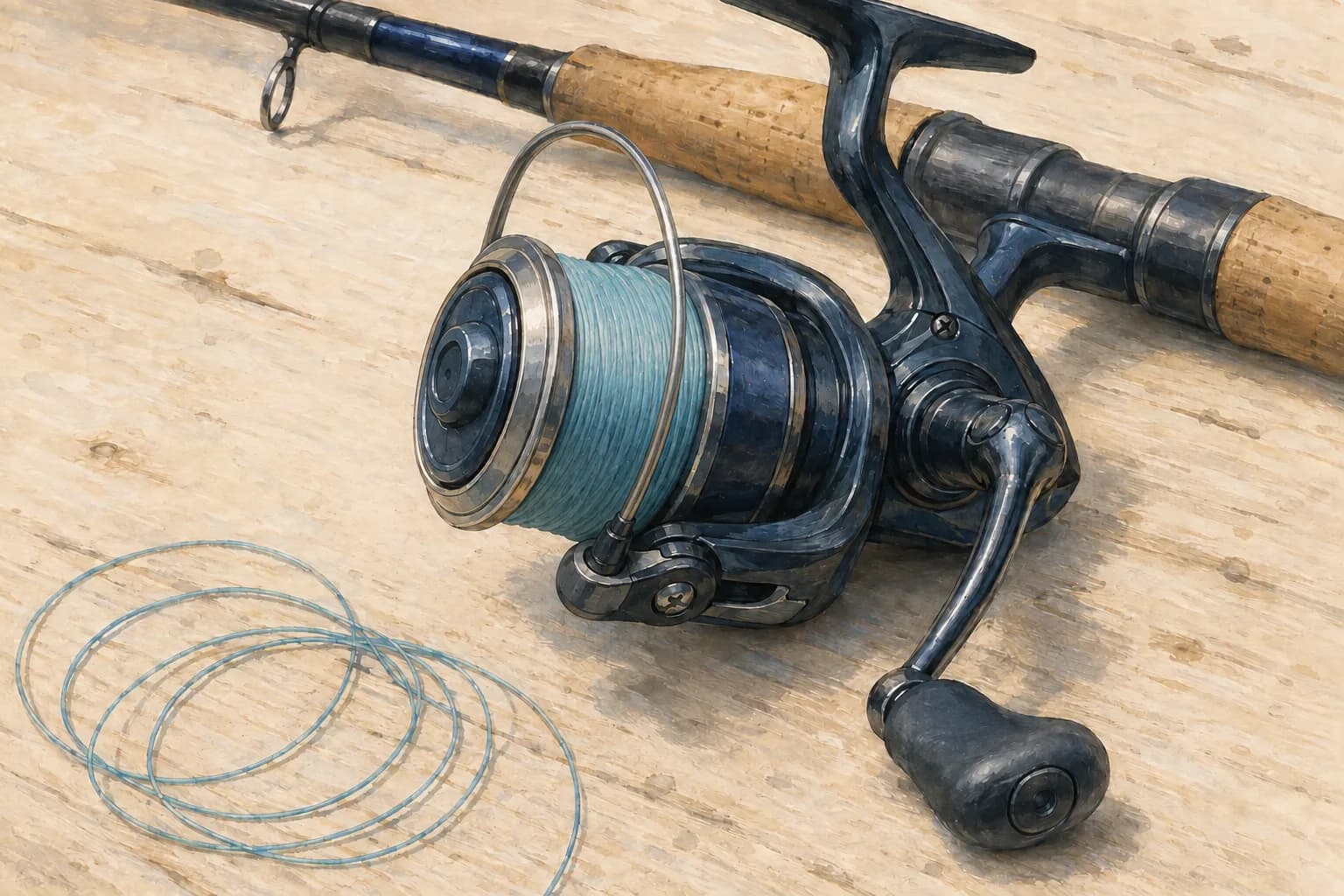
Is it twist, memory, or a loose loop?
With the hook secured or removed, inspect a short slack section in a clear area. Do not pull a tight knot harder just to see what happens. The shape gives you a starting diagnosis, although more than one problem can occur together.
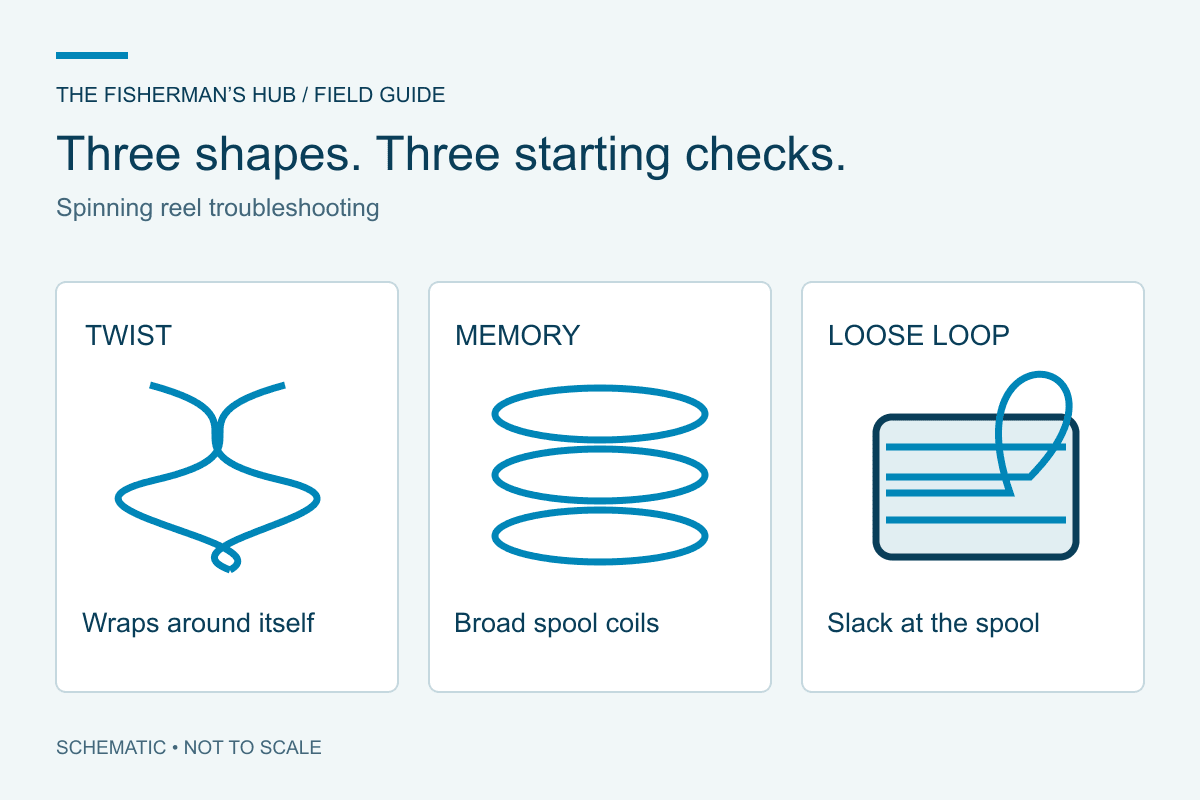
| What you see | Likely issue | First check |
|---|---|---|
| Line doubles back and wraps around itself | Twist | Did it begin immediately after spooling, or only after retrieving tackle? |
| Broad, regular coils resembling the spool | Spool memory, especially in stiff mono | Line age, diameter, and suitability for the reel |
| One slack loop protrudes from otherwise neat line | Loose line lay | Slack retrieval and fill level before the next cast |
| A tight tangle leaves the spool during a cast | Several possible causes | Stop and inspect the spool rather than blaming the wind alone |
Run the five-check diagnosis
Work in a clear space with the hook removed or secured. Keep any loose line contained. The sequence below narrows the cause without changing the reel, line, rig, and filling method all at once. It is not a reason to continue testing a reel that grinds or has a seized part.
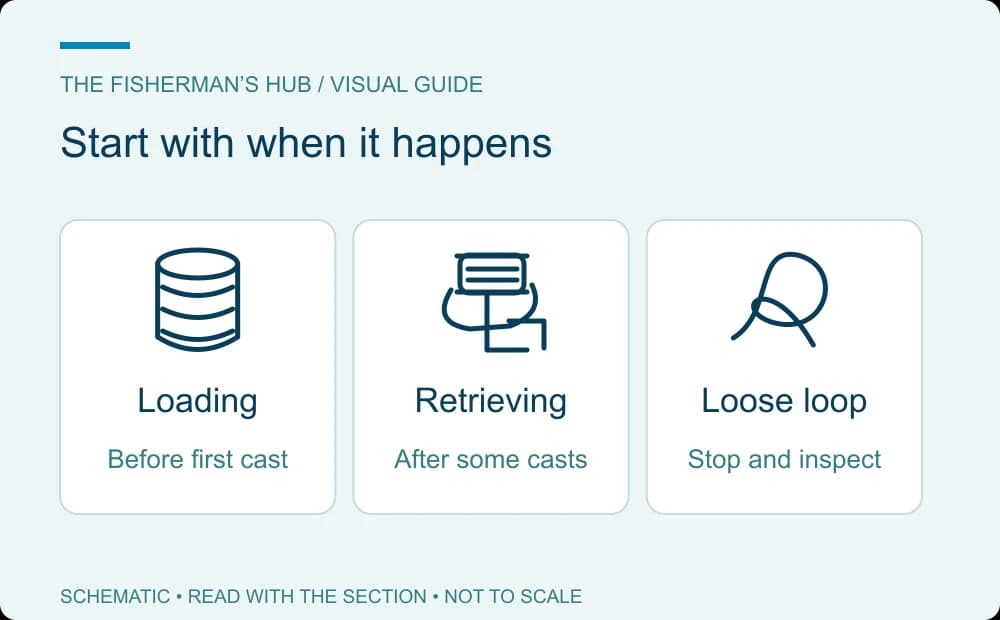
| Check | What you observe | Next useful action |
|---|---|---|
| 1. Before retrieving | The line already coils back around itself | Revisit the loading method and inspect the affected length |
| 2. Spool surface | One loose loop or uneven buildup | Expose the loop; compare fill and line lay with the reel manual |
| 3. Roller and bail | Line misses the roller, or the roller binds | Correct seating; seek model-approved care or service if binding persists |
| 4. Terminal tackle | The bait or lure rotates on retrieval | Correct its rigging or replace the damaged component |
| 5. After one correction | The same symptom returns | Stop repeating that correction and investigate the next cause |
A useful before-and-after comparison
Suppose fresh line looks orderly after loading, then twists after several retrieves with one bait. Record that sequence, inspect how the bait travels, and compare it with a correctly rigged presentation. If the problem disappears, that is a clue about the rig. If it occurs before any retrieve, focus your attention upstream on loading and line management.
If trouble starts while spooling
Check your reel’s own loading instructions first. A universal rule such as ‘always put the label upward’ can be misleading because filling methods differ. Shimano specifically identifies incorrect winding as a cause of twist and says its slow-oscillation models should be filled using the reel.
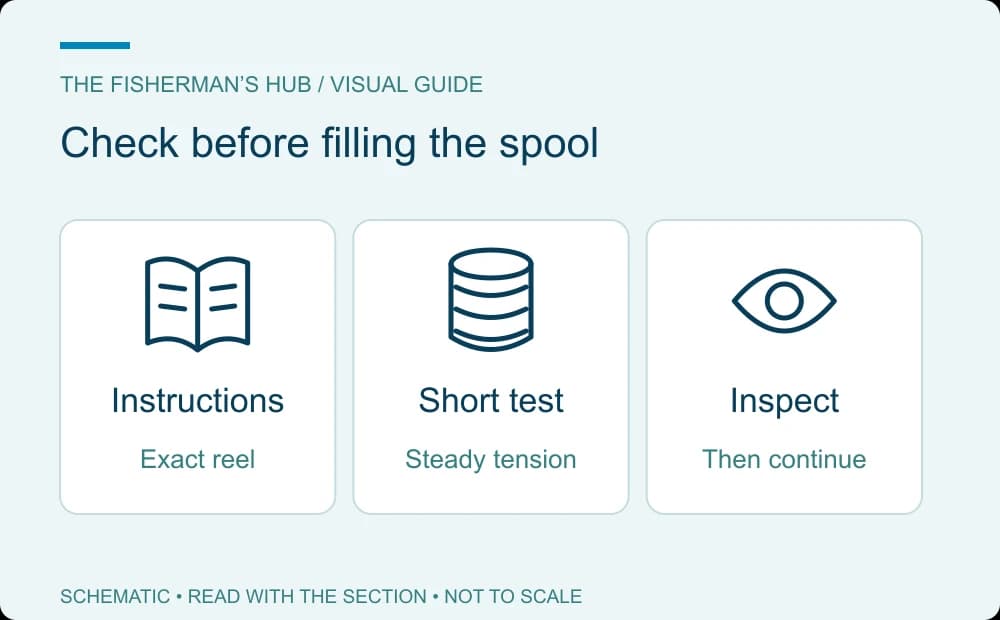
Wind only a short section before checking the result. If loops or self-wrapping appear immediately, stop instead of adding the entire filler spool. Correct the loading method and keep steady, appropriate tension according to the line and reel instructions. Do not pinch moving braid hard with bare fingers.
A spooling tool can hold a filler spool or help with tension. It cannot guarantee that the chosen method matches your reel, repair a seized roller, or remove a badly damaged section of line. If holding the filler spool is the specific difficulty, compare the line-spooler mounting and tension options before choosing a device.
If twist develops during fishing
Note when the problem begins. ‘Fine with a sinker alone, twisted after retrieving this bait’ suggests a different investigation from ‘twisted before the first cast.’ That simple comparison can prevent unnecessary line replacement.
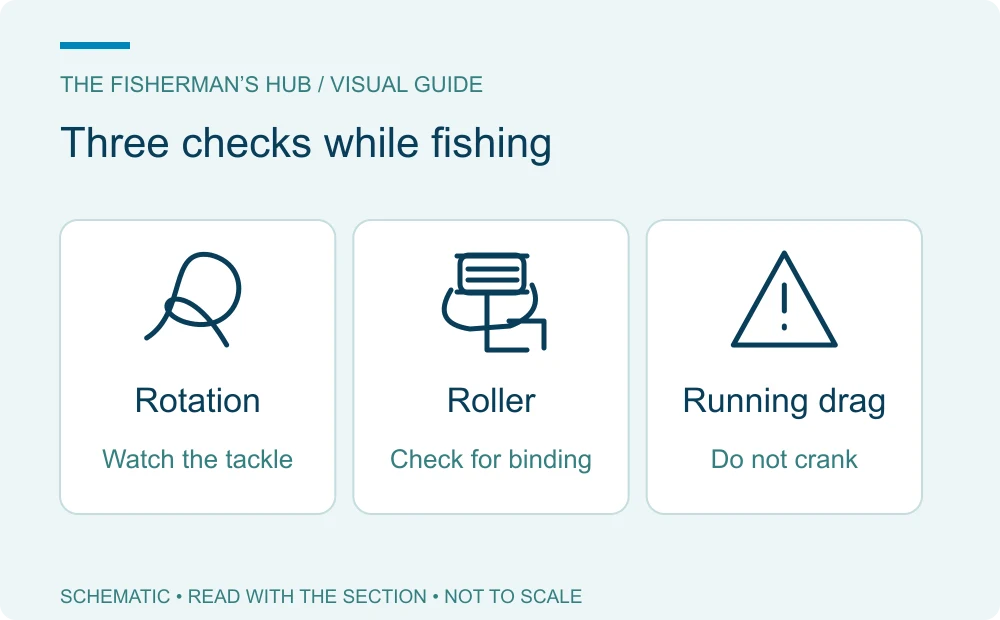
A rotating bait or lure
Inspect the tackle before blaming the reel. A bait attached off-center or a damaged lure can rotate as you retrieve it. Where it is safe to observe, bring it through shallow water beside your position and watch its action. Correct a visibly spinning presentation before making repeated casts.
A binding line roller
Next, check whether line is sitting in the roller and whether that roller moves normally under gentle line movement. Keep fingers clear of hooks. A roller that binds or has become noisy needs attention; Shimano lists a binding roller bearing or bushing as a possible twist cause. Follow the model’s service guidance rather than forcing the part. For routine care after salt exposure, follow the spinning-reel cleaning steps; a binding part still needs inspection rather than a stronger rinse.
Reeling while the fish takes drag
On a spinning reel, continuing to turn the handle while a fish pulls line through the drag can add twist without recovering line. Offshore Angler’s reel manual advises allowing the drag to work during that run, then retrieving when line can be gained. Do not lock down the drag simply to stop the spool turning; keep its setting appropriate to the outfit.
Recover loose line before casting again
If you see a loose loop on the spool, stop turning the handle. Remove the terminal tackle if needed, open the bail, and carefully draw off line until the affected area is exposed. Keep the loose line controlled on a clean surface, away from people, pets, and vegetation. Untangle it gently and check for damage before rewinding.
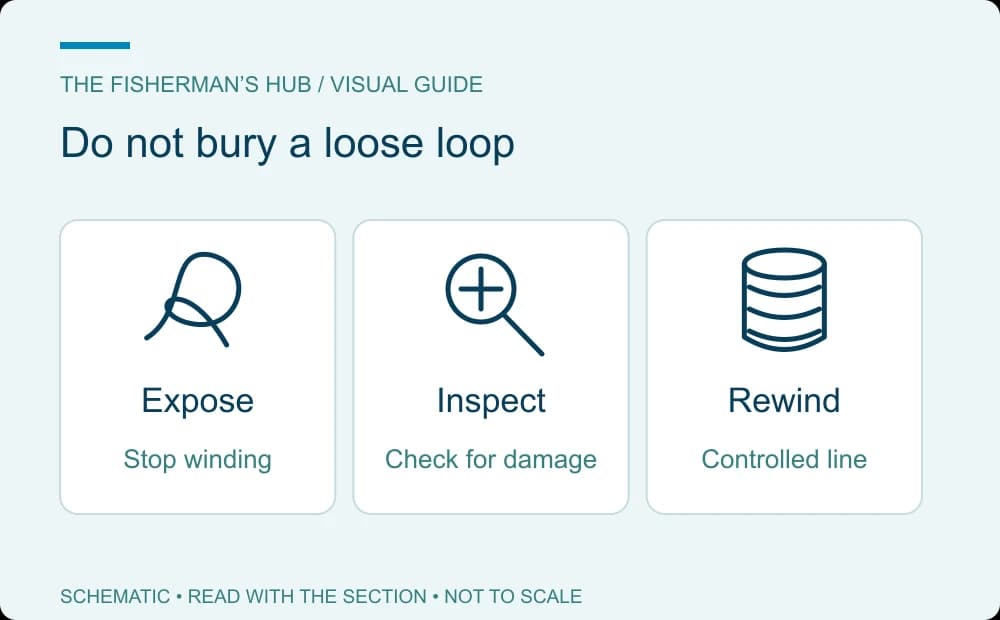
Do not wind a loop deeper into the spool and hope the next cast clears it. When casting, close the bail by hand, make sure the line is seated in the roller, and take up slack before retrieving. These are line-control habits, not a promise to eliminate all twist.
Shimano’s Anti-Twist Fin explanation makes a useful distinction: slack can allow line to drop below the spool or wind abnormally. A tangle after a cast is therefore not proof that your main line was twisted along its whole length.
- Source: Shimano — why suppressing slack helps line management
- Source: Berkley — line materials and handling differences
If the line springs into regular coils
Start by checking what “coiling” means in your case. Regular, springy loops from monofilament can reflect spool memory; a loose loop trapped beneath tighter wraps is a line-lay problem. Both can spill line during a cast, but they need different corrections.
For persistent memory, review whether the line diameter and material suit your reel. Berkley describes materially different handling properties across mono, fluorocarbon, and superlines. That general distinction helps explain why replacing line with the same poorly matched type may reproduce the problem; it does not prove a particular brand will fix your outfit. Our surf-fishing main-line comparison covers material and diameter tradeoffs if inspection shows that the current line is unsuitable.
Check the manufacturer’s fill level too. Do not remove an arbitrary measured depth of line from every reel, and do not top up an already full spool to gain reserve. Avoid improvised heat or solvent treatments unless the line manufacturer explicitly supports them for that product.
Decide whether to recover or replace the line
Replace line with hard kinks, abrasion, or a tightly cinched knot you cannot remove without damage. If trouble extends deep into the spool and you cannot restore orderly line lay, respooling is more dependable than fishing over hidden tangles.
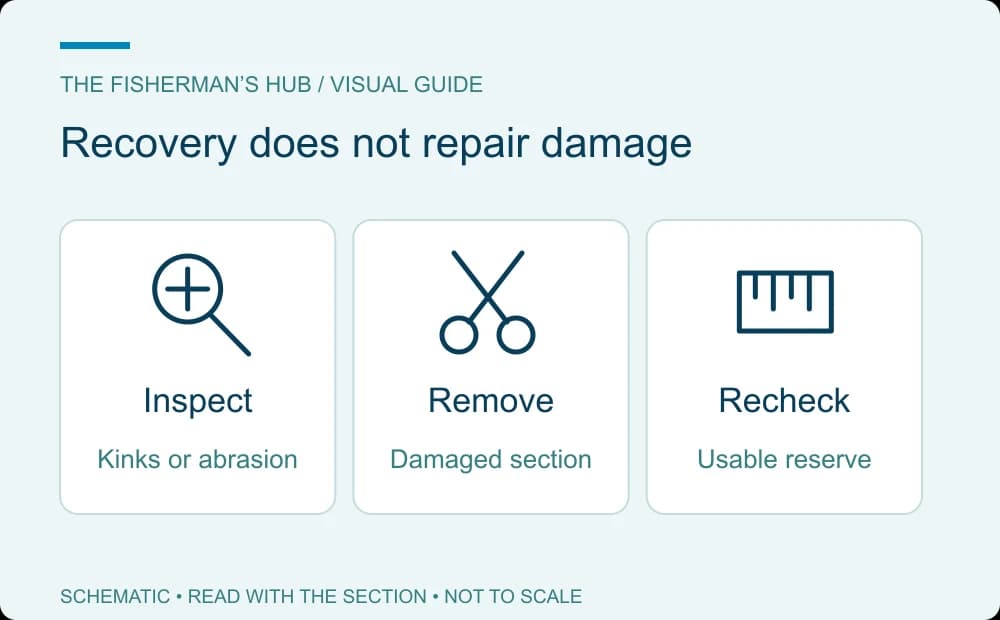
For a short, untangled section that coils back on itself, removing the tackle and allowing the free end to rotate in a controlled space may help release twist. It will not reverse abrasion or make permanently kinked line trustworthy. Keep every length under control and collect discarded line; do not trail it into the surf as a disposal method.
Before cutting off a large amount, check how much usable main line remains. Solving a tangle should not leave your normal cast almost reaching the backing connection. Use the usable main-line length calculation to reassess your reserve after trimming.
Common line-twist questions
These answers cover the decisions that often come up when applying the steps above.
What causes line twists?
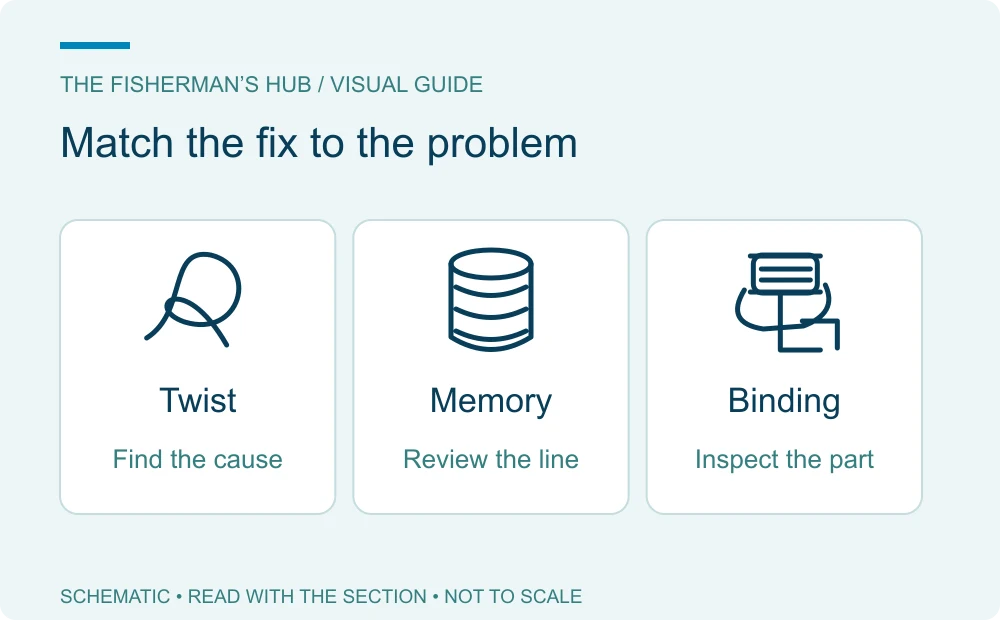
Incorrect loading, rotation from the tackle, a binding roller, or winding against a running drag can contribute. First check whether you have actual twist, regular spool memory, or loose loops; the visible tangle alone does not identify the cause.
How do I keep my fishing line from twisting?
Follow the reel’s loading instructions, inspect how the bait or lure tracks, and notice when the problem begins. Keep slack under control and stop to correct a loose loop rather than winding over it.
How do I stop fishing line coiling off the spool?
Check whether the coils are springy line memory or slack winding spilling from the spool. Review material, diameter and the manufacturer’s fill level for memory; correct tension and line lay for loose loops.
Will a swivel or a new reel solve the problem?
A suitable swivel can help when the tackle introduces rotation, but it will not correct a bad fill or repair a binding roller. Inspect first; persistent mechanical problems call for model-specific service advice before replacing the reel.