
Calculate usable main line, not package length
Use three separate numbers: the line your longest normal cast puts out, the reserve you want remaining at that point, and what you expect to lose before the next refill. Reserve depends on the fish and location; it is not a fixed percentage of casting distance.
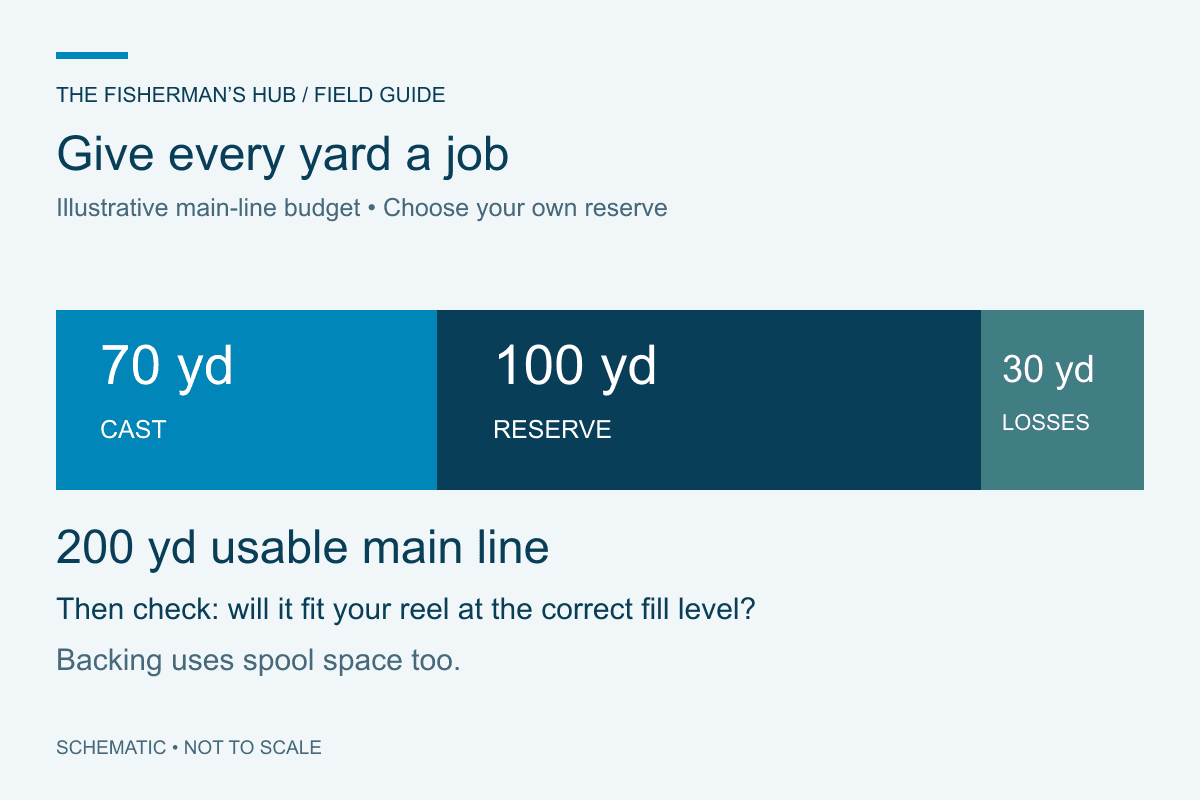
In an illustrative shore-fishing plan, a 70 yd cast plus 100 yd of reserve plus 30 yd for future trimming totals 200 yd of usable main line. The 100 yd reserve is an assumption in this example, not a verified requirement for every fish. Strong current, larger running fish, or different access can demand a different plan.
Do not treat this example as a shark-fishing setup or advice for species that routinely need specialized capacity. If you cannot estimate the demands of the target fish, ask a local tackle shop or experienced local guide before selecting the outfit.
| Part of the plan | Example | Question to answer |
|---|---|---|
| Longest normal cast | 70 yd | How much line will actually be outside the reel? |
| Reserve after the cast | 100 yd | What fish and conditions are you preparing for? |
| Future trimming and losses | 30 yd | How much might you remove before refilling? |
| Starting usable main line | 200 yd | Will this amount fit at the correct fill level? |
Compare 150, 200, and 300 yards for the same cast
Work backward from the cast. With 150 yd loaded and 70 yd outside the reel, 80 yd remains before any future trimming. Whether that is adequate depends on the reserve your fishing requires. If you later cut away 25 yd, that same cast leaves only 55 yd.
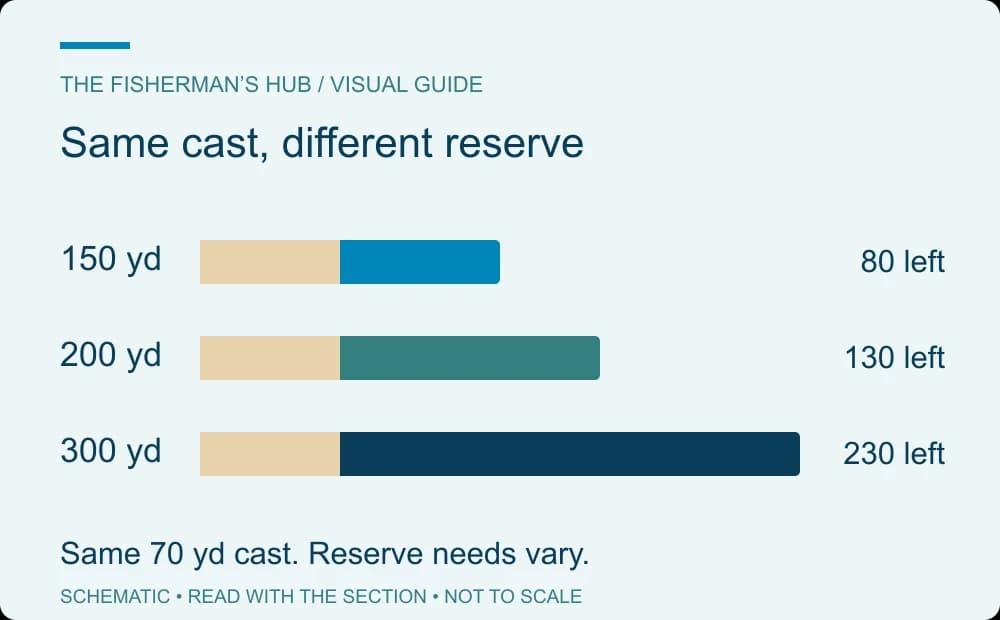
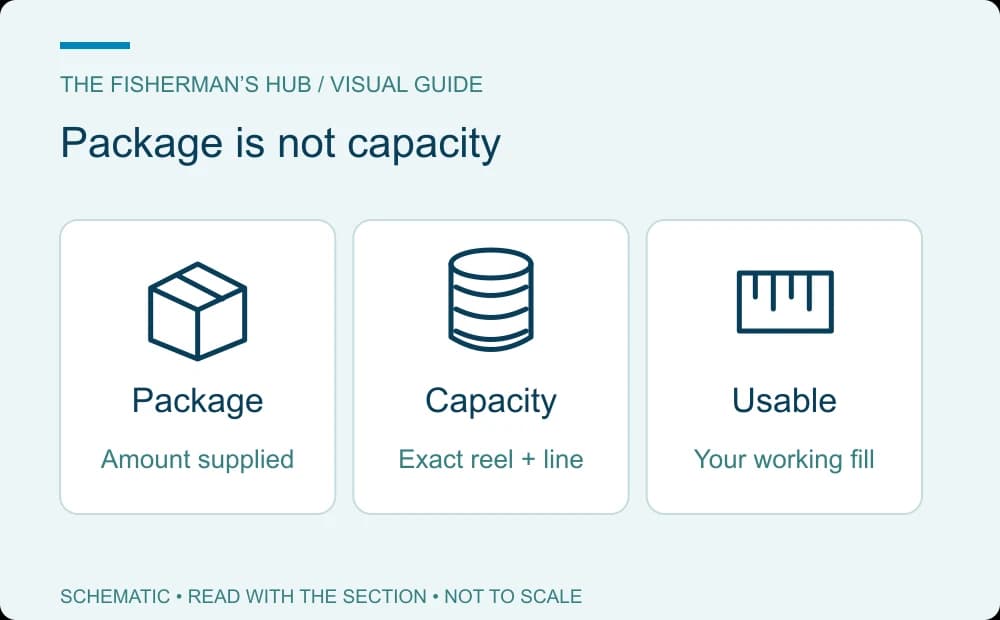
A 300 yd package gives you more material to work with, but the reel still has to hold the chosen amount properly. A large package may supply multiple refills or leave line unused. Buying a bigger package is not the same as increasing the capacity of the reel.
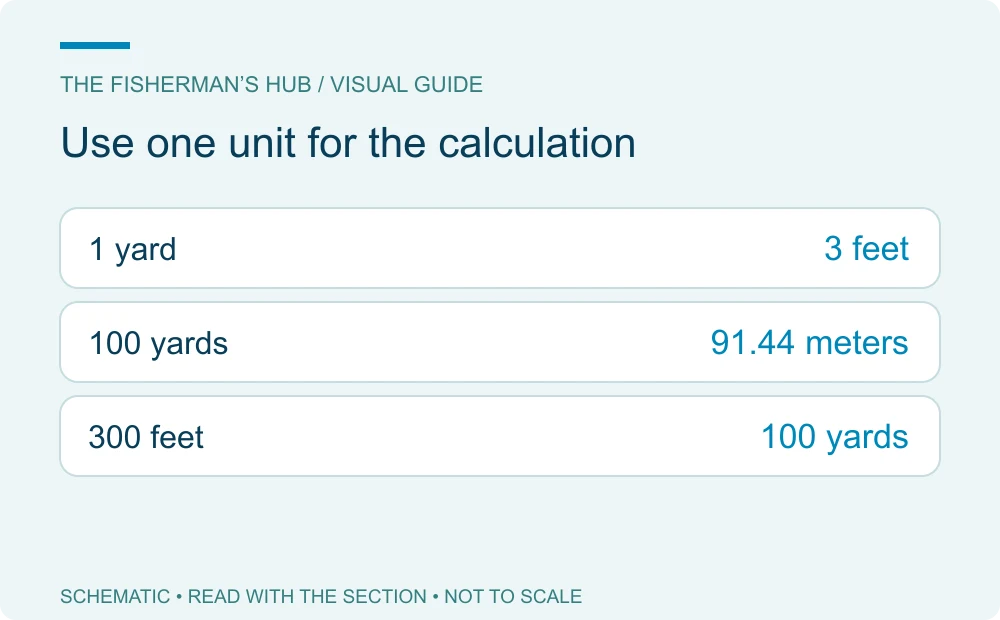
Also check the units. Three hundred feet is only 100 yards. If a line counter displays feet and the package uses yards, divide the counter reading by three before comparing them.
| Starting usable line | After trimming | Remaining after the cast |
|---|---|---|
| 150 yd; no trimming | 150 yd | 80 yd |
| 150 yd; 25 yd removed | 125 yd | 55 yd |
| 200 yd; 30 yd removed | 170 yd | 100 yd |
Why the trimming allowance matters
In the first example, the outfit can make exactly the same cast after losing 25 yd, so nothing about that cast warns you that the reserve has fallen from 80 yd to 55 yd. This is why “it still casts far enough” is not a complete capacity check. Track losses instead of relying only on the casting feel.
What if the backing knot becomes reachable?
If your normal cast approaches the connection, you have used almost all of the top section. Review the fill before fishing again. A planned backing system with a known connection differs from unexpectedly discovering an old knot at the end of your working line.
Match the plan to your exact reel and line diameter
PENN lists the Pursuit V 4000 (PURV4000) at 260 yd of 20 lb braid or 185 yd of 30 lb braid. In its mono column, the same model lists 220 yd of 10 lb line or 165 yd of 12 lb line. These are alternative fills, not lengths you add together.
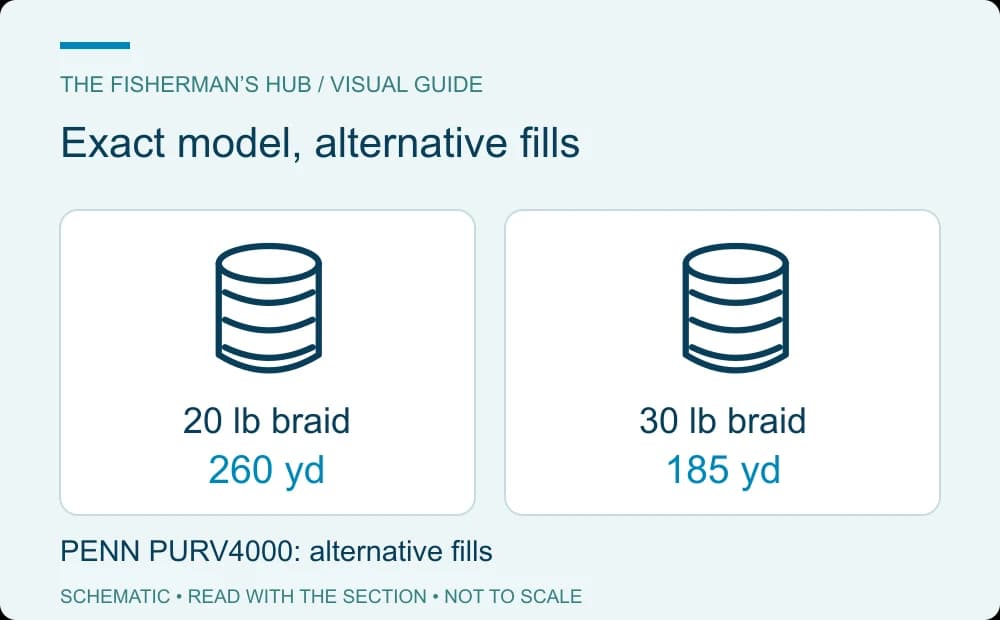
Those figures illustrate why material and diameter matter. A nominal breaking strength does not guarantee identical diameter between brands, and practical fill can vary with line packing. Confirm the exact size and model code rather than copying the capacity from another reel in the same family.
For the hypothetical 200 yd plan above, a listed 185 yd capacity does not meet the plan before you even allow for backing. Resolve that mismatch by reconsidering the suitable line and reel combination or the fishing plan. Do not simply overfill the spool. Our surf reel capacity comparison helps you compare exact models once you know the usable length you need.
Allow room for backing
Backing sits underneath your working main line. It can help achieve the required spool fill without using expensive braid for the entire spool, where that arrangement suits the reel’s instructions. But it consumes some of the spool volume.
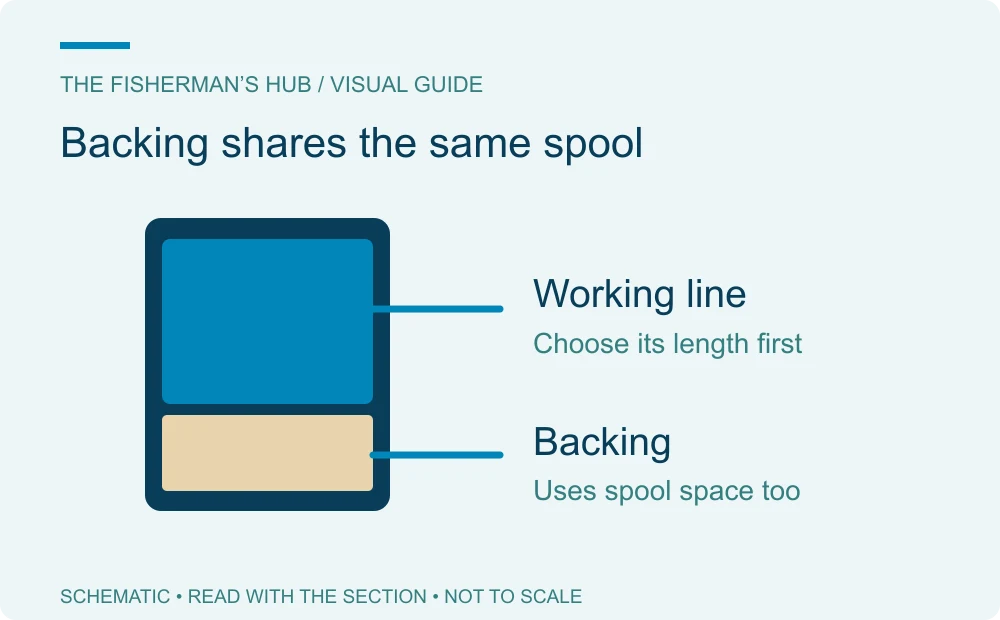
If your plan requires 200 yd of usable braid, fitting 150 yd of braid over backing does not give you 200 yd of braid. The backing and connection might be capable of carrying load in a deliberately designed system, but that is a different plan. Do not rely on an unknown knot buried years ago as your emergency reserve.
Choose the main-line amount first. Then determine how much, if any, backing leaves the spool at the manufacturer’s recommended fill level. Inspect the connection during a refill and record what is actually on the reel. A leader at the tackle end has a different job from backing under the spool; the fishing leader guide explains that distinction.
Keep yards, feet, and meters consistent
Keep one unit throughout the calculation, then convert once if necessary. A counter reading in feet is not a reading in yards, and a reel label using meters is not directly comparable with the yard figure on a retail package. These are length conversions, not reel-capacity guarantees.
| Starting figure | Equivalent length |
|---|---|
| 300 ft | 100 yd |
| 150 yd | 450 ft; about 137 m |
| 200 yd | 600 ft; about 183 m |
| 300 m | About 328 yd |
Why matching pound-test is not enough
Capacity is about the amount of physical line that fits. Two products carrying the same breaking-strength label may use different diameters. Read the reel’s braid or mono column that matches your planned material, check diameter where supplied, and treat the resulting length as nominal until you have filled the reel properly.
Record the fill and check before your next trip
Use the reel and line manufacturers’ spooling method and fill-level guidance. Avoid a universal ‘fill it to the lip’ rule. Stop periodically to inspect line lay and keep an estimate of how much working line went on. If loops appear while filling, diagnose line twist and loose line lay before winding more line over the problem.
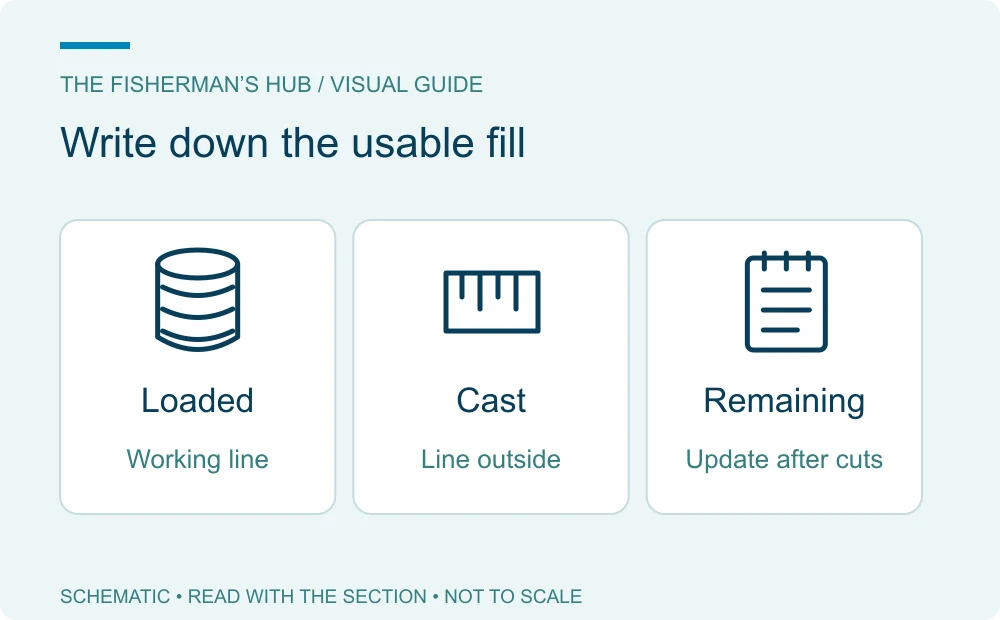
Write down the date, material, strength or diameter, approximate main-line length, and backing arrangement. After a serious tangle or break-off, update the estimate. Several small cuts can eventually remove a large part of the reserve.
A counter is useful only if you understand its units and accuracy. Treat an uncalibrated reading as an estimate, especially when the exact remaining length would decide whether the setup is suitable. If uncertain, remeasure or refill before a trip where capacity matters.
You should be able to answer four questions before leaving: how much usable main line is loaded, how much your cast puts out, what reserve remains, and how that compares with the demands of the trip. If one answer is unknown, inspect or measure the setup at home rather than discovering the limit with a fish attached. For the remaining outfit decisions, continue with the surf-fishing setup builder.
This calculation helps you choose a length. It does not choose the correct breaking strength, leader, drag setting, or abrasion resistance. Those still need to match the rod, rig, fish, and beach. Compare surf main-line materials and strengths only after defining those demands.
| Write down | Your figure or source |
|---|---|
| Usable main line loaded | _____ yd / m |
| Longest normal cast | _____ yd / m |
| Reserve remaining after that cast | Loaded length − cast = _____ |
| Future trimming allowance | _____ yd / m; included in the original plan |
| Exact reel, line and fill level | Model / diameter / manufacturer instructions |
Common surf-line capacity questions
These answers cover the decisions that often come up when applying the steps above.
Is 150 yards enough for surf fishing?
Subtract your longest normal cast and consider the reserve that remains. In the worked example, a 70 yd cast leaves 80 yd from a 150 yd fill before future trimming; whether that meets the trip’s demands is a separate decision.
Does a 300-yard package mean my reel holds 300 yards?
No. Package length tells you what you are buying, while the reel’s capacity depends on the exact spool and line diameter. Only load the amount that fits at the recommended fill level.
Does backing count as usable main line?
Backing occupies space under the working line. If the plan requires 200 yd of usable braid, 150 yd of braid over backing does not meet that braid-length plan. A deliberately designed backing system is a different arrangement.
Why do two lines with the same pound-test fit differently?
Nominal breaking strength does not guarantee identical diameter. Material, actual diameter and how the line packs on the reel all affect the fill, so check the specific product and reel rather than relying on pound-test alone.