
How to Tie a Palomar Fishing Knot in 5 Steps
The quick answer
Tie the Palomar knot in five steps
- Double the line
Push the folded loop through the hook eye.
- Tie one loose overhand knot
Keep the doubled strands flat and leave the knot open.
- Pass the tackle through
Move the whole hook, lure, snap, or swivel through the loop.
- Check and wet it
Move the loop above the eye and wet the line with clean water.
- Seat and test it
Pull slowly, test the knot firmly, then trim the tag end.
- Standing line
- The line that goes back to your reel.
- Tag end
- The short, loose end you trim after testing the knot.
- Doubled loop
- The folded section that passes through the eye and over the tackle.
Watch the five steps
See the Palomar knot tied slowly
This 40-second video shows the same five steps as the guide below. The captions are always visible, and you can also open the full transcript.
Read the video transcript
- Fold the line into a loop. Slowly push the folded end through the hook eye. Then leave room to work.
- Tie one loose overhand knot with both strands. Keep the hook below and the large loop open.
- Now open the large loop. Carefully move it over the whole hook until all of the hook has passed through.
- Move the loop above the hook eye and keep both strands flat, then wet the line with clean water before pulling.
- Pull both ends until the knot is snug. Test it. Trim the tag, and leave a short tail.
Detailed tying guide
Keep the two strands flat
The knot is simple, but the doubled line must stay neat. If the strands cross, the knot can bunch instead of sitting cleanly against the eye. Start again rather than forcing a messy knot tight.
Use thick cord and a large eye bolt, or cover the hook point before you learn. Never pull a sharp hook toward your hand or face.
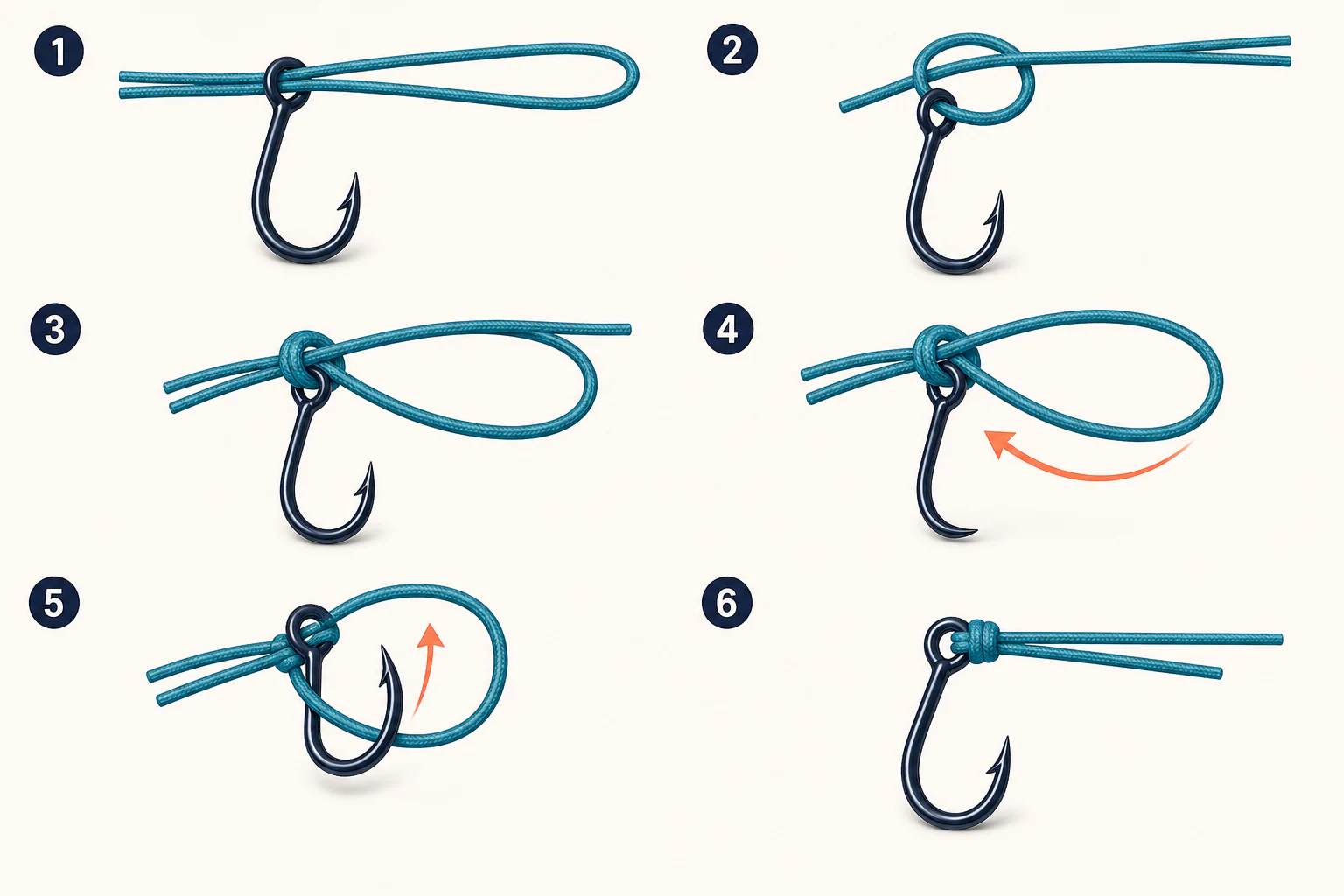
Step 1 Double the line
Make a loop long enough to pass over the whole hook or lure. Push the folded loop through the eye.
Step 2 Tie one loose overhand knot
Let the hook hang below the knot. Keep the two strands side by side, and do not tighten them yet.
Step 3 Pass the tackle through the loop
Open the loop and move it over the entire hook, lure, snap, or swivel. Clear every point and part.
Step 4 Check and wet the knot
Guide the loop above the eye. Make sure the doubled strands are flat, then wet the line with clean water.
Step 5 Seat, test, and trim
Pull the standing line and tag end slowly. When the knot sits against the eye, give it a firm pull test, then trim the tag while leaving a small visible tail.
Before you cast
Check the finished knot
- The doubled strands are flat, not crossed.
- The knot sits snugly against the eye.
- The line has no frays, sharp kinks, or rough spots.
- A firm pull test does not make the knot move.
- A small, visible tag remains after trimming.
If any check fails, cut the knot off and tie it again on clean line. A neat second try is better than hoping a damaged knot will hold.
Pick the knot for the job
When to use a Palomar knot
Use it for a terminal connection when the eye accepts two strands and the entire tackle item can pass through the loop. Choose another suitable knot when either part is awkward.
| Situation | Choice | Why |
|---|---|---|
| Hook, small lure, snap, or swivel | Use the Palomar | It is designed to attach line to terminal tackle. |
| Braid, mono, or fluorocarbon | Use it when it seats cleanly | The knot can work with all three line types. Follow the line maker’s advice when it differs. |
| Bulky or multi-hook lure | Choose another terminal knot if needed | The whole lure must pass through the doubled loop without catching you. |
| Eye is too small for a folded loop | Thread once and back, or change knots | The eye still must hold two strands without damage. |
| Main line to leader | Use a line-to-line knot | A Palomar is a terminal knot, not a two-line connection. See where both leader connections fit. |
| Frayed or kinked line | Cut back and retie | No knot repairs damaged line. |
Braid, mono, and fluorocarbon
Adjust how you check the knot
- Braided line
- The Palomar is a common choice for braid. Keep both strands flat, seat the knot slowly, and always pull-test it before casting.
- Monofilament
- Wet the line and pull steadily so the knot slides into place. Retie if the line looks stretched, rough, or pinched.
- Fluorocarbon
- Wet it, tighten slowly, and inspect the line beside the knot. Follow the line maker’s knot advice if it recommends a different connection.
No single strength percentage is honest for every line. Diameter, material, condition, and the way the knot is tied all change the result.
A practical comparison
Palomar knot vs. Uni knot
There is no universal winner. A Palomar uses doubled line and only one loose overhand knot, but the hook or lure must pass through a loop. A Uni uses wraps and can be slid down to the eye, so it may be easier with a bulky lure.
Choose the knot you can tie neatly with your line and tackle. This page teaches only the Palomar so the steps stay clear.
Troubleshooting
Fix a Palomar knot that looks wrong
- The doubled strands cross.
- Cut or loosen the knot and start again. Keep the two strands side by side from the eye onward.
- The loop will not clear the lure.
- Retie with a longer loop. If the lure is still awkward to pass through safely, use another suitable terminal knot.
- The overhand knot tightened too early.
- Retie it. The overhand knot must stay loose until the tackle has passed through the loop.
- The knot bunches away from the eye.
- Wet the line and guide it slowly. If it has already cinched into a rough shape, cut it off and retie.
- The line looks cloudy, kinked, or frayed.
- Cut back to undamaged line before tying again.
- The knot moves during the pull test.
- Do not cast it. Retie and check the line maker’s recommended knot for that exact line.
Sources
Official guidance checked for this page
- Utah Division of Wildlife Resources — tying sequence, wetting the line, and pulling slowly.
- Florida Fish and Wildlife Conservation Commission — doubled line, loose overhand knot, and avoiding twists.
- Alaska Department of Fish and Game — use with braid, monofilament, and fluorocarbon, plus terminal vs. line-to-line knots.
- Kentucky Department of Fish and Wildlife Resources — threading through a small eye and the core tying steps.
- New York State Department of Environmental Conservation — flat doubled strands, complete loop clearance, and braid guidance.
Reviewed Aug. 25, 2026. These sources describe the method, but no knot is a guarantee. Inspect your line, tie carefully, and test every connection before you cast.