
What is an FG knot?
An FG knot connects two different lines. Animated Knots says it securely joins braided line to a leader. Braid is fishing line woven from many thin strands. A leader is a shorter piece of line tied to the end of your main line, the line on your reel. Daiwa US describes the FG as a way to tie braid to a monofilament or fluorocarbon leader. Monofilament, or mono, and fluorocarbon are both single-strand lines.
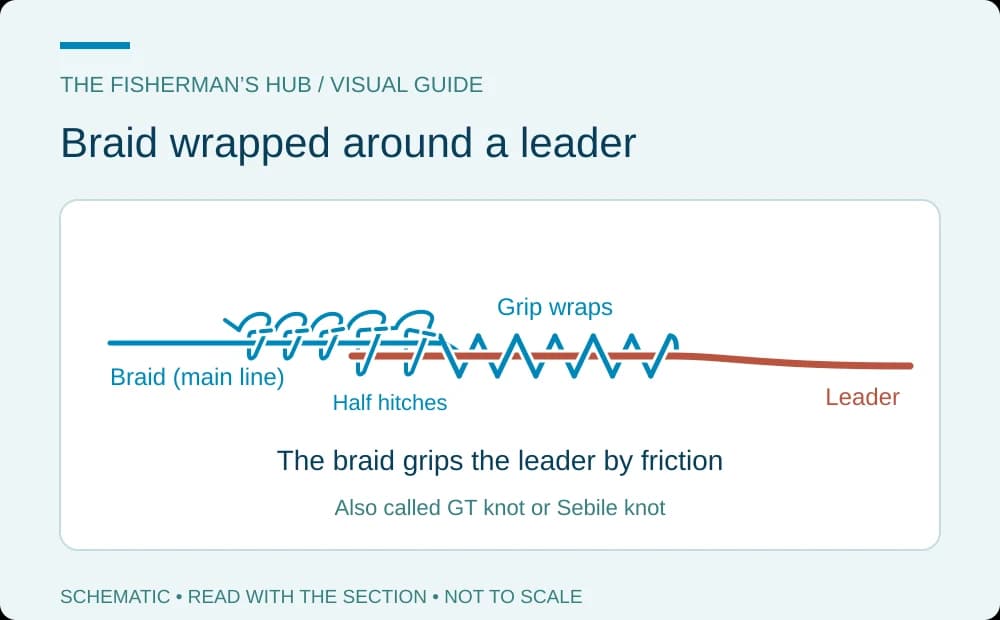
There is no bulky knot in the middle. Instead, Sunline America says, the braid wraps tightly around the leader, making a friction-locked connection. Animated Knots calls this grip a Chinese finger grip, like the woven finger toy that tightens when you pull. Salt Strong says the knot stays thin because the thicker leader never doubles over, as it does in more traditional knots.
Animated Knots says the knot is valued for its strength and its ability to run freely through the guides. Rod guides are the rings along the rod that the line passes through. Daiwa US also says it runs through the guides and is extremely smooth. Salt Strong is more careful: it says not to cast the knot through the guides. The catch: Animated Knots calls it somewhat complicated to learn.
You may see two other names. Animated Knots lists GT knot, after the giant trevally, a large tropical fish. It also lists Sebile knot, after Patrick Sébile, who supposedly introduced it. The meaning of FG is not settled; suggested explanations include Fine Grip.
The double uni knot is a different way to join two lines: two uni knots, each tied around the other line, slide together. Sunline America's comparison table labels it a quick tie. The steps are in the double uni knot guide.
Set up tension before you start
Every source starts with the same rule: keep the braid tight. NetKnots calls tension on the lines the key to tying this knot quickly and successfully. Tackle Warehouse says the key is tension on the braided main line before you start. Animated Knots says that whatever method you use, the line must be kept tight.
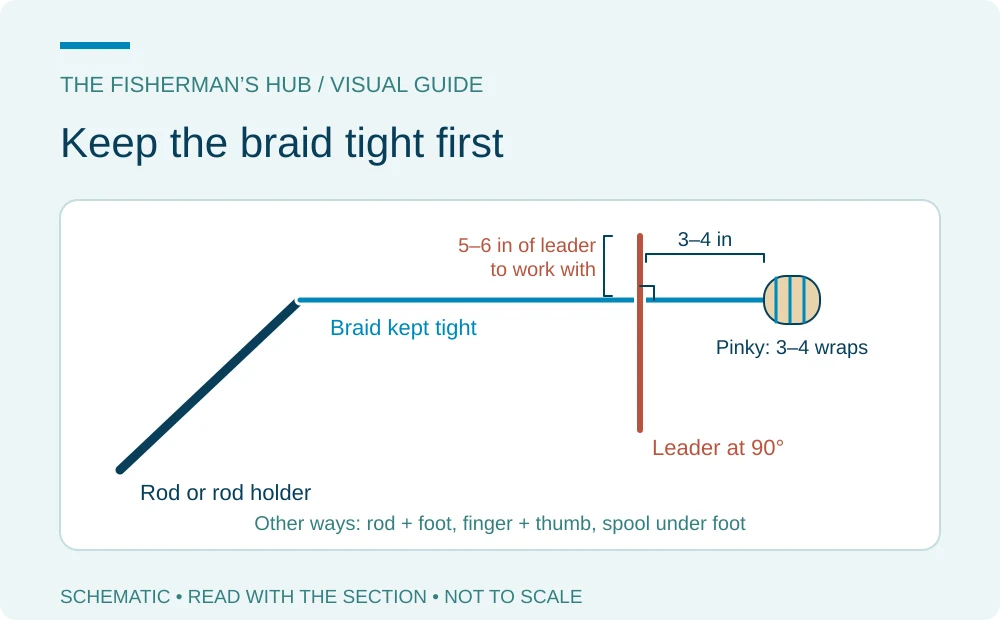
Once the braid is held tight, place the leader. Tackle Warehouse lays it across the braid at a 90-degree angle, a right angle, about 3–4 inches above your pinky. It leaves about 5–6 inches of leader to work with. That short working end is the leader's tag end: the loose end you tie with.
One difference in wording: Sunline America asks for light tension on the braid, while Daiwa US says to pull nice and hard. Both keep the tension on the whole time.
Your hands will be busy with the leader, so something else has to hold the braid. These are the methods the sources describe. Pick one that feels steady to you:
- Rod and foot, finger and thumb, or hand and mouth: the three options Animated Knots lists.
- Braid wrapped around your pinky finger: used by Salt Strong, Daiwa US, and Tackle Warehouse. Tackle Warehouse wraps it 3–4 times.
- Rod in a rod holder: Tackle Warehouse keeps the rod still so you can pull against it without a second person.
- Leader spool under your foot, with the leader running up over your knee: NetKnots uses this to keep the leader tight while the braid stays stretched over your index finger and thumb.
- Teeth: Salt Strong shows a teeth method, but its author prefers the pinky method because it doesn't require holding the line in his teeth.
How to tie an FG knot, step by step
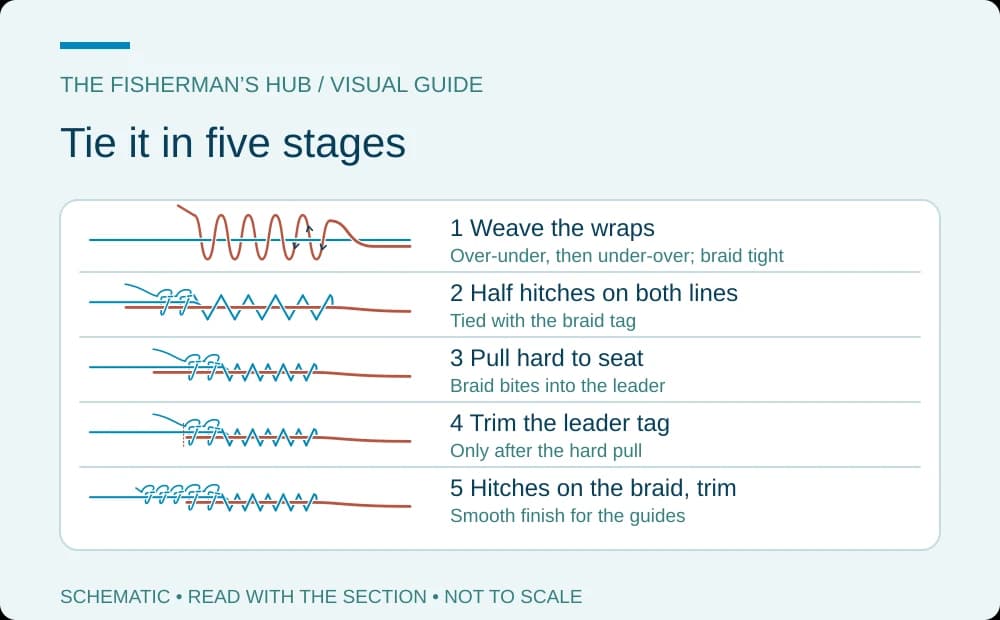
These five steps follow the pattern the six sources share. Where a step needs a number, it is an example from one source. The next section compares all the counts.
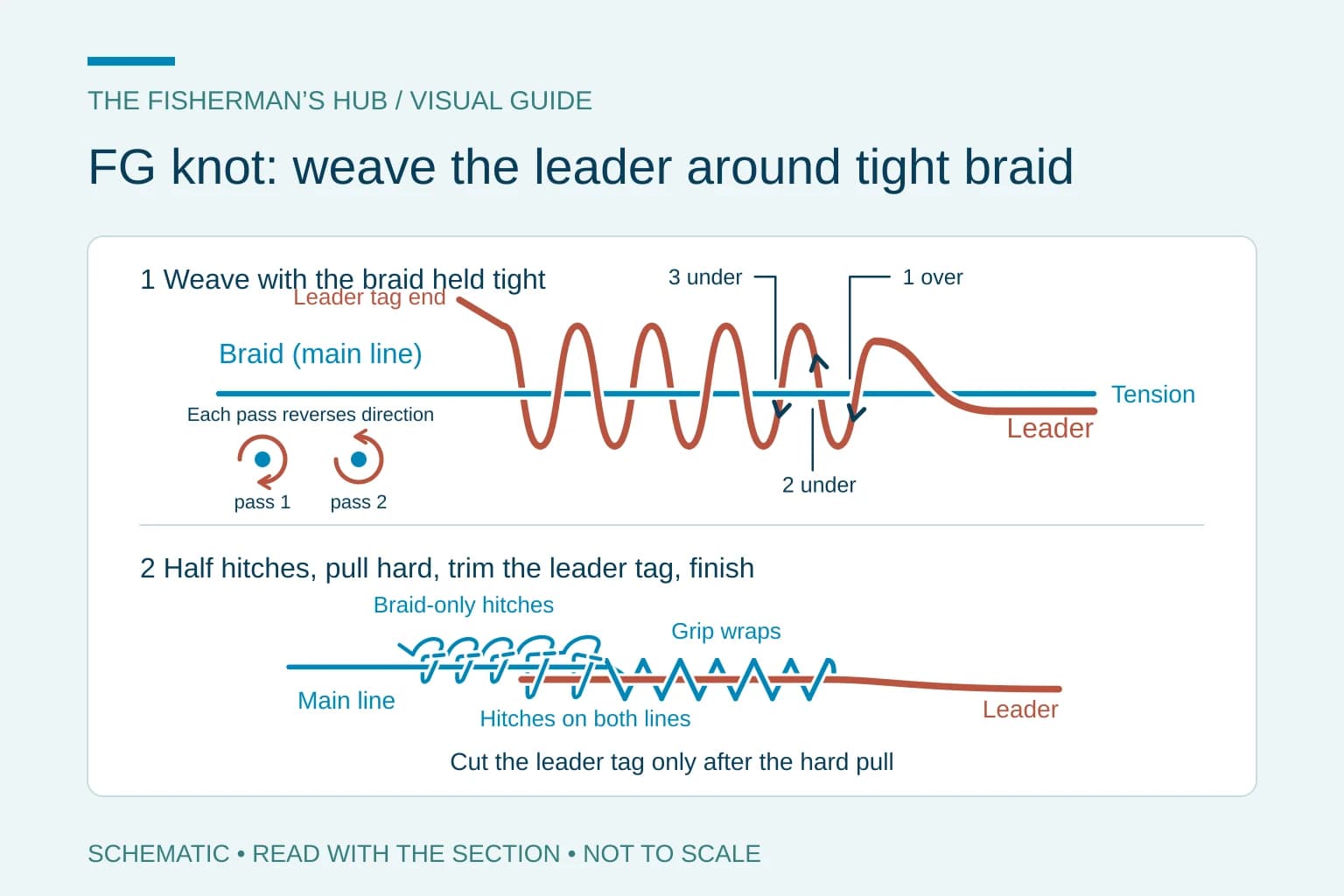
Two words come up a lot. A wrap is one pass of the leader around the braid. A half hitch is a simple locking loop: you pass the tag end around the line and back through the loop it makes, then pull it snug.
- Source: Animated Knots — FG knot
- Source: NetKnots — FG knot
- Source: Salt Strong — how to tie the FG knot
- Source: Tackle Warehouse — how to tie an FG knot
1. Weave the wraps
Take the leader's tag end over the braid, then under it, then over again, switching sides each time. Salt Strong places the leader above the braid and alternates a wrap over with a wrap under. Animated Knots wraps the leader first under one side and then under the other. NetKnots calls it weaving: down one side, up through the middle, down the other side.
Keep the leader tight as you go. NetKnots says to keep very strong tension on it. The wraps tend to spread out, so Animated Knots pushes the stack together after every five or six pairs of wraps.
For example, Salt Strong stops at 16 wraps. Other sources use other counts; check the table in the next section before you start.
2. Lock the wraps with half hitches
Pinch the wraps so they cannot slide. Use the braid's tag end to tie half hitches around both lines, the braid and the leader together. For example, Salt Strong and Tackle Warehouse tie two here. Salt Strong says to make sure both the leader and the main line are inside these knots.
3. Pull hard to seat the knot
To seat a knot means to pull it tight so it settles into its final, gripping shape. Hold the braid in one hand and the leader in the other, and pull hard in opposite directions. Salt Strong wraps the braid around a hand a few times and pulls until the braid digs into the leader. The seating section below explains why this step decides whether the knot holds.
4. Trim the leader tag
Only now cut off the leftover leader end, close to the knot. Salt Strong says to cut it after you put tension on the knot, because the wraps typically slide up a bit when you pull.
5. Finish on the braid and trim
Tie more half hitches with the braid's tag end, this time around the braid only. Salt Strong adds two so the top of the knot is smoother and the hard edge of the cut leader does not snag on debris or rod guides. Tackle Warehouse ties 2–4 here and says some anglers use a uni knot for this step instead. Then trim the braid tag.
The other end of the leader still needs a hook or lure. For that separate knot, see how to tie a Palomar knot.
How many wraps does an FG knot need?
There is no single answer. The six sources give different numbers, and they do not all count the same way. Animated Knots counts double wraps, meaning pairs: one wrap on each side. Most others count single wraps. NetKnots gives a length to weave instead of a count.
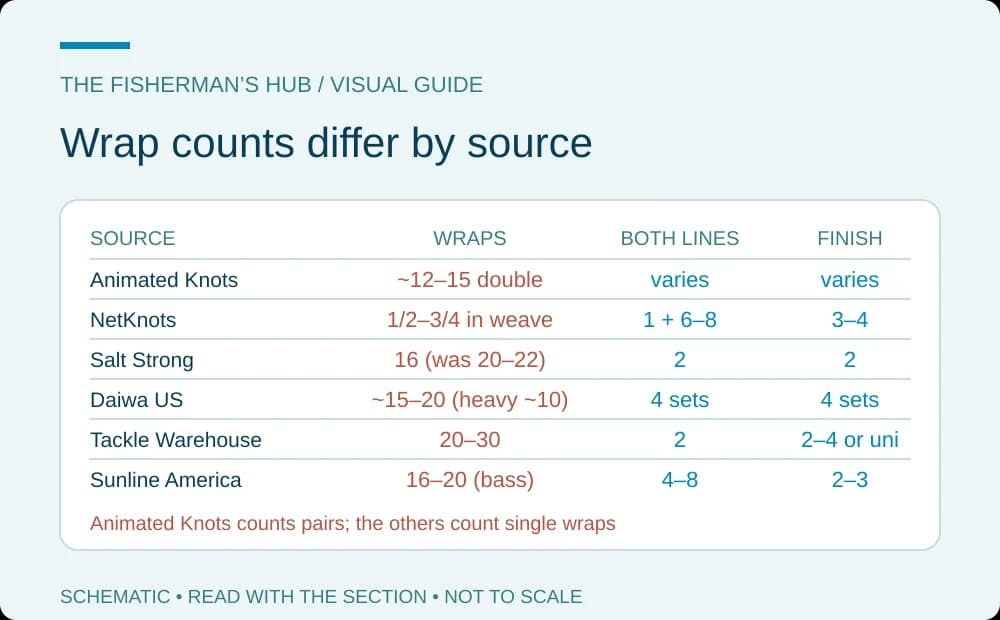
Most sources say line weight changes the count. NetKnots says to make more wraps for lighter line and fewer for heavy line. Tackle Warehouse gives the same rule of thumb and mentions up to 30 wraps for light 4–10 lb leader. Daiwa US says that in heavier line you can get away with about 10. It adds that fluorocarbon needs more wraps than nylon mono, because fluorocarbon is harder.
Sunline America points the other way for light line. For bass fishing it suggests 16–20 wraps and says lighter lines can use fewer. That conflicts with NetKnots and Tackle Warehouse, so follow one source's whole method instead of mixing numbers.
Counts also change over time. Salt Strong's author used to recommend 20–22 wraps and now uses 16.
Still choosing how heavy your braid should be? The surf fishing line guide covers line types and strength. Then practice the knot at home before you need it on the water. Animated Knots says that with practice it can be tied quickly and reliably.
| Source | Wraps | Half hitches on both lines | Finishing hitches on the braid |
|---|---|---|---|
| Animated Knots | About 12–15 double wraps | Number varies widely | Number varies widely |
| NetKnots | Weave about 1/2–3/4 in long; more for lighter line | 1, then about 6–8 more | 3–4 |
| Salt Strong | 16 (used to say 20–22) | 2 | 2 |
| Daiwa US | About 15–20; heavier line sometimes about 10 | 4 alternating sets | 4 sets |
| Tackle Warehouse | 20–30; up to 30 for light line | 2 | 2–4, or a uni knot |
| Sunline America | 16–20 for bass | 4–8 | 2–3 |
Seat the knot: the pull that makes it hold
This is the make-or-break step. Tackle Warehouse calls it one of the most crucial steps of the FG knot and the place where most failures occur. If you skip it, the leader will slip out of the braid.
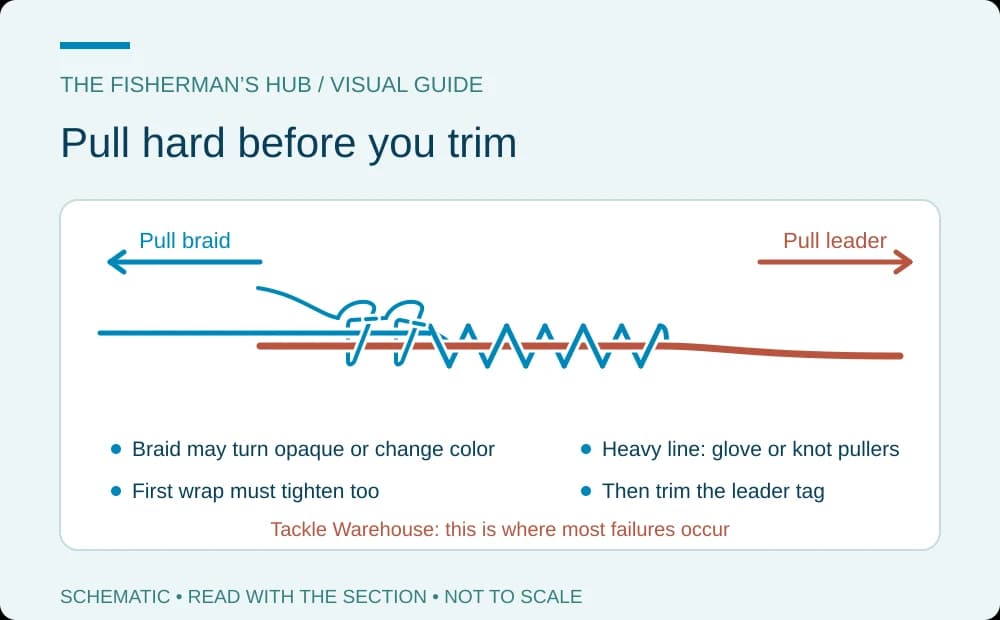
Animated Knots explains why. The final strong pull stretches the last six to ten wraps and tightens the grip. Salt Strong says the knot only works if the braid digs into the leader. NetKnots says to pull very hard in opposite directions and get any slippage out now.
How can you tell it is seated? Watch the braid. Daiwa US says the braid over the knot turns opaque and slowly changes color as it tightens. Tackle Warehouse says the lines will sometimes change color and the braid should be tight all the way to the last wrap. Salt Strong says the first wrap matters most; if it has not tightened, the knot can come undone.
Pulling hard on braid can cut your hands, especially with heavy line. Daiwa US wraps each line around a small grip stick, the back end of a pair of pliers, or a gloved hand. Tackle Warehouse uses knot pullers, simple handles you wrap the line around. It warns not to wrap the line over itself on them, because that can cut or damage the line.
Only after this pull do you cut the leader tag. Salt Strong calls tightening the wraps before cutting the leader tag the most important part to remember.
How strong is the FG knot?
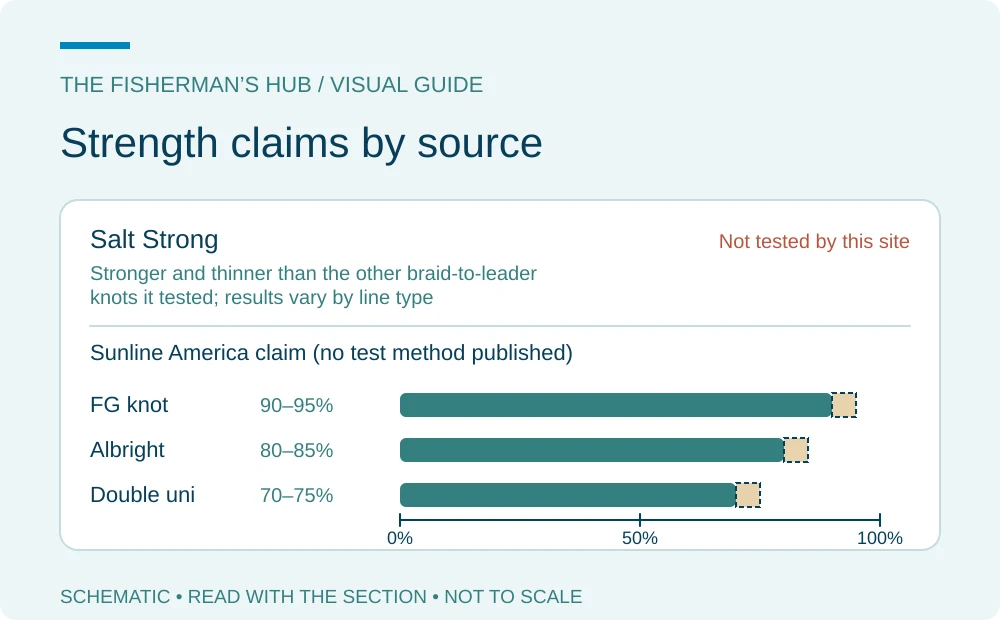
This site did not test the knot. The strength claims below come from the sources, and they do not come from one shared test.
Animated Knots says the FG is valued for its strength, but gives no number.
Salt Strong ran its own braid-to-leader knot tests. It reports that the FG proved stronger and thinner than the other braid-to-leader knots it tested. It also warns that breaking results change with the line types used, and suggests trying the FG on your own gear against the knot you use now.
Sunline America, a fishing line maker, claims the FG keeps up to 95% of the line's original strength. Its comparison table lists the FG at 90–95%, the double uni at 70–75%, and the Albright at 80–85%. The page does not say how those numbers were measured. Treat them as one company's claim, not a lab result.
Daiwa US quotes an angler who uses the FG on everything from 4 pounds up to 200 pounds. Pounds here means pound test, the weight a line is rated to hold. That range is one person's habit, not a rating for the knot.
Strength is not the only thing to weigh. Sunline's table rates the double uni lower but labels it a quick tie, and Animated Knots calls the FG somewhat complicated to learn. If you are still deciding on the leader itself, the fishing leader guide explains what mono and fluorocarbon leaders do.
Fix an FG knot that slips or snags
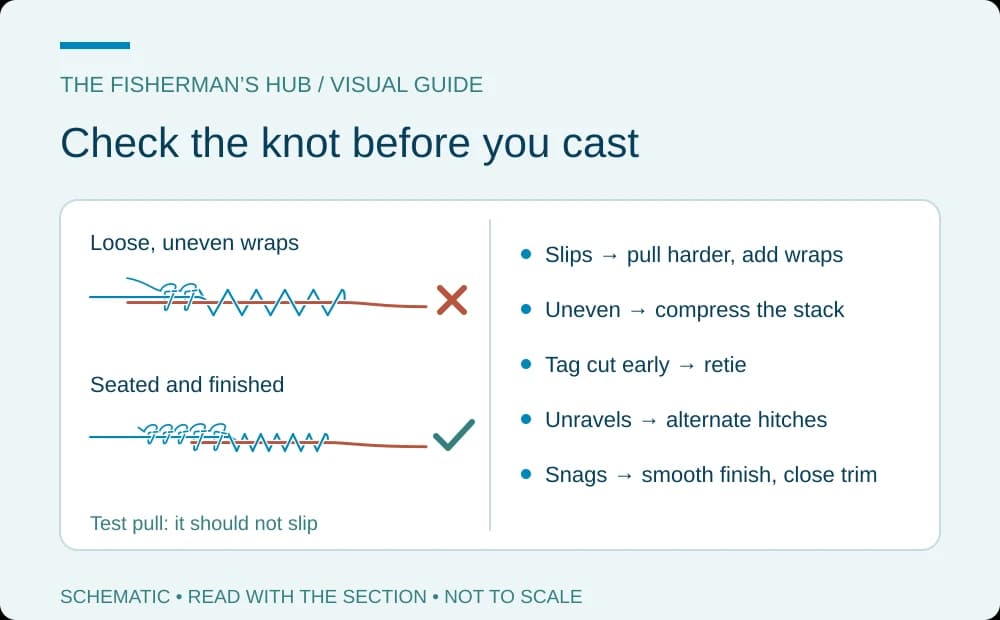
Test every FG knot before you fish with it. NetKnots says to pull hard to check the finished knot; it should not slip. If you see one of the problems below, cut the knot off and tie a new one.
- Source: NetKnots — FG knot
- Source: Tackle Warehouse — how to tie an FG knot
- Source: Sunline America — how to tie the FG knot
- Source: Animated Knots — FG knot
- Source: Salt Strong — how to tie the FG knot
- Source: Daiwa US — how to tie an FG knot
The leader slips out
Tackle Warehouse says the leader slips out of the braid when you skip the hard pull. Sunline America adds that too few wraps can pull out under hard hooksets; a hookset is the sharp pull that drives the hook in. Retie with the full wrap count from your source and seat it hard before you trim.
The wraps are uneven or loose
Sunline America warns that loosely stacked, uneven wraps can slip under tension. Keep the braid tight, keep pulling the leader as you weave, and push the stack together every five or six pairs, as Animated Knots does.
You cut the leader tag too early
Salt Strong and Sunline America both say to seat the wraps before cutting. Salt Strong explains that the wraps typically slide up a bit when you pull. If you trimmed first, retie and do the hard pull before you cut.
The finish comes undone
Daiwa US alternates its half hitches, one under and the next over, so they lock back against each other. Animated Knots notes that some anglers tie them all the same way and others alternate. Tackle Warehouse mentions an optional small dab of super glue on the last half hitch.
The knot catches in the rod guides
The sources do not agree here. Animated Knots and Daiwa US both say the FG runs through the guides. Salt Strong is more careful. It says the knot serves you well as long as you only use it to join braid to a stronger mono or fluorocarbon leader and do not cast it through the guides. It also warns that a loose first wrap risks the knot coming undone, especially if you cast through the guides.
So a smooth finish helps, but it is no promise that the knot will pass the guides cast after cast. Salt Strong's finishing half hitches give the knot a smoother top so the cut leader end does not snag. Tackle Warehouse says cutting the tag ends very close to the knot helps it pass through the guides smoothly. Pull the first wrap tight before you trim.