
What is a double uni knot?
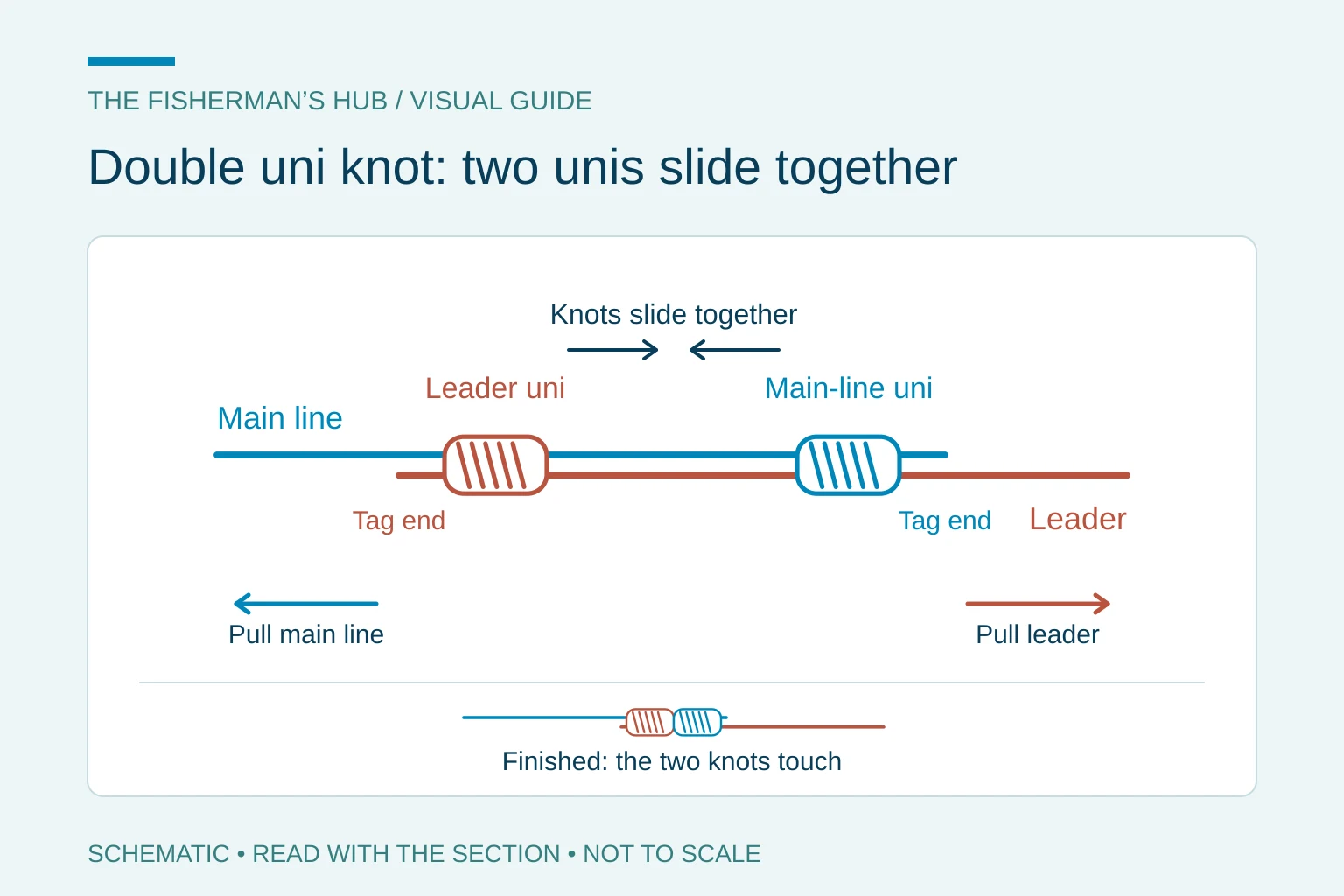
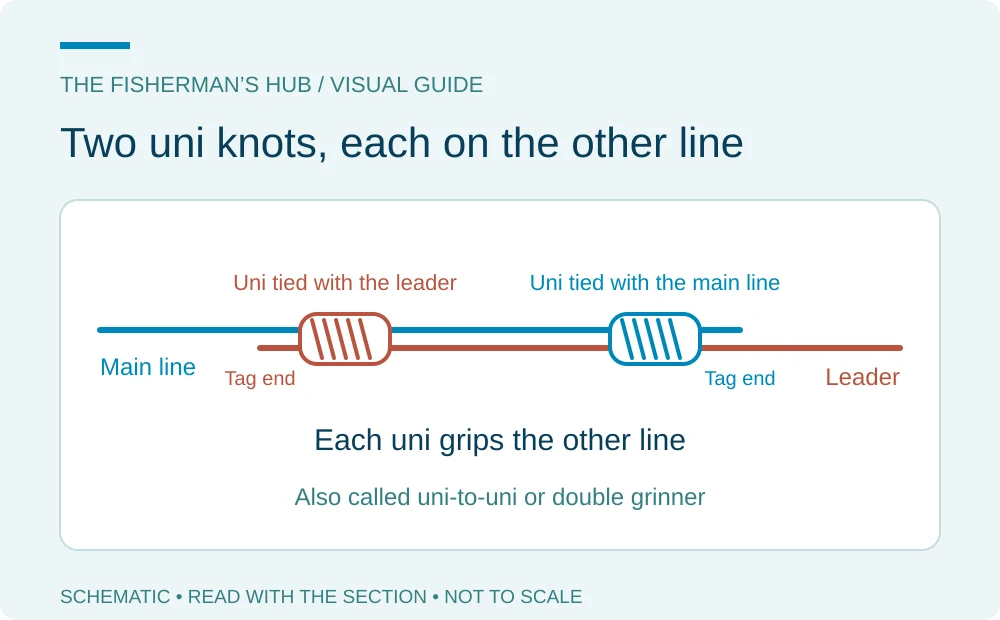
A double uni knot joins two fishing lines end to end. You tie one uni knot with each line, and each knot wraps around the other line. Then you pull the two knots together. The tag end is the short, loose end you tie with. The standing line is the long part of the line that does the work. Animated Knots says each knot is tied around the other line's standing end.
It is not a knot for tying on a hook. A knot that ties line to a hook, lure, or swivel is called a terminal knot. For that job, see how to tie a Palomar knot. The double uni joins line to line.
You will also see it called the uni-to-uni knot, the name Take Me Fishing uses on its braid-to-fluorocarbon page. Animated Knots adds the name double grinner. It also says Norman Duncan invented the uni knot, so it is sometimes called the Duncan knot. Outdoor writer Vic Dunaway later published it as the uni knot, as part of his Uni Knot System.
Take Me Fishing calls it great for attaching a leader to your main line. The main line is the line on your reel. The leader is a shorter piece tied to its end, nearest the hook or lure. Orvis quotes Zoe Angling saying the knot suits backing to backing, monofilament to monofilament, and braided line to monofilament. Backing is extra line wound onto a reel under the main line. Braid is line made of woven strands. Monofilament, or mono, is a single strand. Fluorocarbon is another single-strand line. Take Me Fishing's own examples include braid to a mono or fluorocarbon leader.
Before you tie: overlap, direction, and water
Lay the two lines side by side so their ends overlap and point in opposite directions. FishTrack describes this as two parallel line ends in opposing directions. The overlap gives each line enough tag end to make its wraps. A wrap, which some guides call a turn, is one pass of the tag end around the lines.
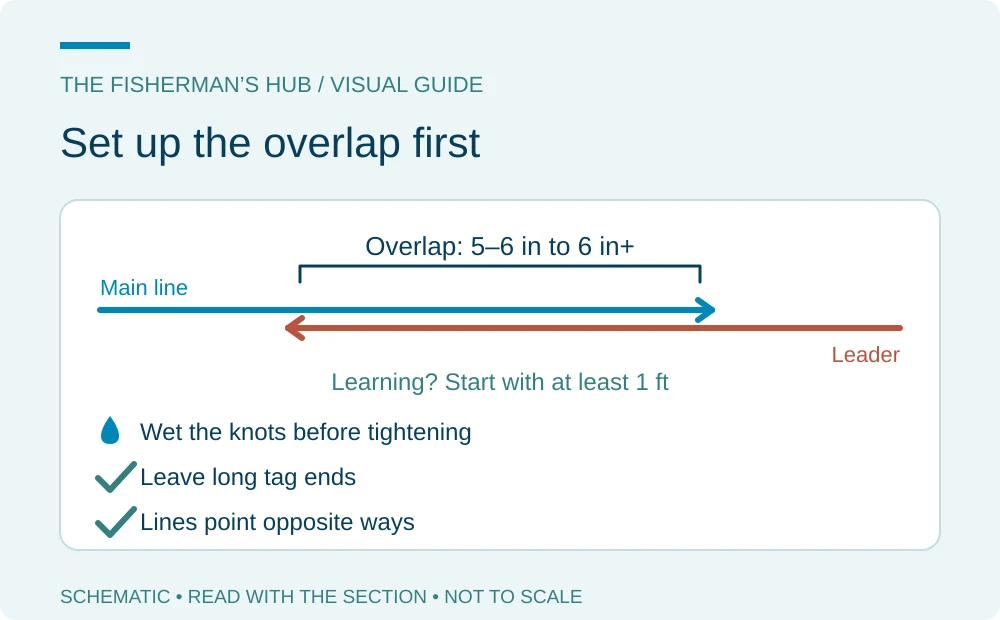
Have water or saliva ready. Take Me Fishing says to moisten the knots before tightening to prevent line damage from friction. The Utah Division of Wildlife Resources adds that friction heat can stretch and weaken fishing line.
Leave long tag ends. Take Me Fishing's line-joining page says to leave plenty of line at the end of each knot, because those ends help pull the two knots into one.
The sources ask for different overlap lengths. While you learn, the foot-long start from Take Me Fishing gives you room to fix mistakes, and you trim the extra at the end. Here is what each source says:
- Take Me Fishing, double uni page: about 5 to 6 inches.
- Take Me Fishing, uni-to-uni page: about 6 inches.
- FishTrack: at least 6 inches.
- Take Me Fishing, line-joining page: at least 1 foot until you know how much you need.
How to tie a double uni knot, step by step
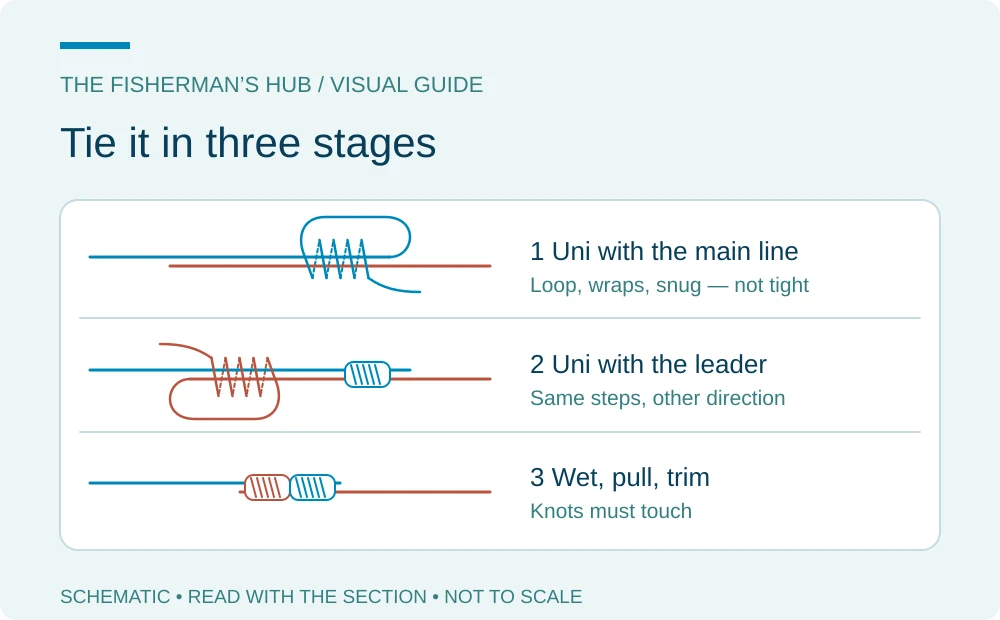
These steps follow FishTrack and Take Me Fishing. In them, the main line comes in from the left and the leader from the right. You tie the same knot twice, once with each line, and then join the two knots.
Pick your wrap counts before you start. The next section compares what each source uses.
- Source: FishTrack — how to tie the double uni-knot
- Source: Take Me Fishing — how to tie a double uni knot
- Source: Take Me Fishing — line-joining knots
- Source: Daiwa Australia — double uni tech tip
Tie the first uni
1. Lay the lines side by side in opposite directions, with the overlap you chose.
2. Take the tag end of the main line and bend it back to make a loop over both lines. FishTrack uses a loop about 2 inches across, crossing the lines near the middle of the overlap.
3. Pinch the loop against the lines. Pass the tag end around both lines and through the loop. Repeat until you reach your wrap count.
4. Pull the tag end to close the wraps. Take Me Fishing says to snug the knot up, but not pull it tight yet.
Tie the second uni
5. Repeat the same steps with the leader's tag end, wrapping it around the main line. Make this loop go the other way. Take Me Fishing's line-joining page forms the first loop clockwise and the second counterclockwise, so the two knots face opposite directions.
6. Snug the second knot up, but not tight. You now have two uni knots a short distance apart.
Slide the knots together
7. Wet both knots and the line between them.
8. Hold the main line in one hand and the leader in the other. Pull them away from each other so the knots slide along the lines until they meet. FishTrack calls snugging the knots tightly against each other essential for maximum strength.
9. Pull each tag end to finish tightening. In the Daiwa Australia video, the presenter cinches the leader tag first, then the main-line tag.
10. Trim the tag ends. Take Me Fishing says the finished knot should look like a barrel. The fixes section below explains how close sources say to cut.
How many wraps does a double uni knot need?
There is no single number. Each source gives its own count, and one gives no separate count for braid. The table at the end of this section puts them side by side.
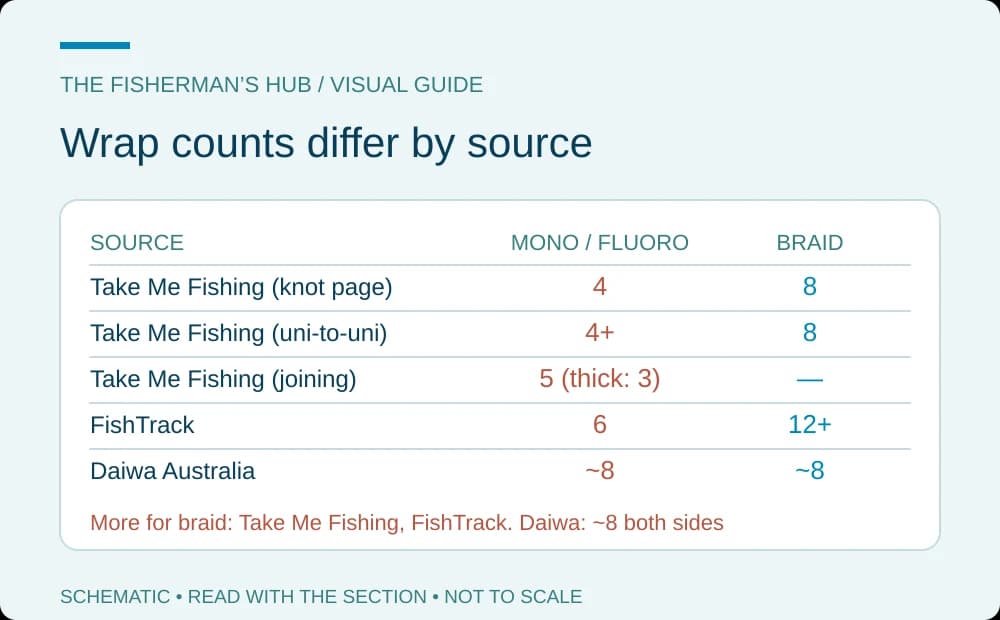
Not every source uses more wraps for braid. Take Me Fishing doubles the count from 4 to 8 for braid. FishTrack uses 6 turns, or 12 or more with braid. Daiwa Australia does not: its presenter uses about eight wraps on both sides. Take Me Fishing's line-joining page gives 5 wraps, or sometimes 3 with a thicker leader, with no separate count for braid. In its note on braid that is much thinner than the leader, FishTrack says to at least double the braid-side turns to prevent slippage.
If your line maker gives its own knot advice, follow it for that line.
Practice at home before you need the knot on the water. The Utah Division of Wildlife Resources recommends taking your time and practicing each knot until you trust it.
| Source | Mono or fluorocarbon side | Braid side | Note |
|---|---|---|---|
| Take Me Fishing — double uni page | 4 wraps | 8 wraps | Doubles the wraps when the line is braid. |
| Take Me Fishing — uni-to-uni page | At least 4 wraps on fluorocarbon | 8 wraps | Written for light braid to a fluorocarbon leader. |
| Take Me Fishing — line-joining page | 5 wraps; a thicker leader may need only 3 | No separate braid count | Uses 5 wraps on each line in its steps. |
| FishTrack | 6 turns | 12 turns or more | Thin braid is sometimes doubled as well. |
| Daiwa Australia | About 8 | About 8 | Video ties braid main line to a leader. |
Using it to tie braid to a mono or fluorocarbon leader
Take Me Fishing names braid to a mono or fluorocarbon leader as a good time to use this knot. Its uni-to-uni page calls it a simple, strong braid-to-fluorocarbon knot for beginners to start with.
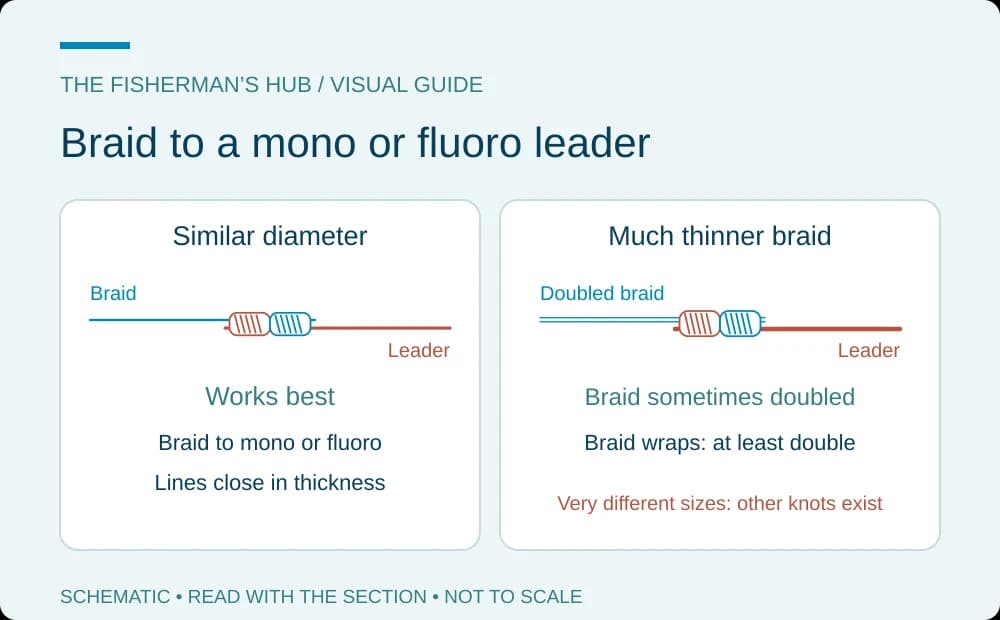
Line thickness matters. Diameter is how thick the line is. Take Me Fishing says the two lines do not need the same diameter, but the connection is strongest when they are not dramatically different. FishTrack and the expert quoted by Orvis also say the knot works best with lines of similar diameter.
When the braid is much thinner than the leader, FishTrack says the braid is sometimes doubled, so two strands are used as one. In that case, it says to at least double the turns on the braid side. When the diameters are dramatically different, Take Me Fishing says other knots and rigs work better. It does not name them, and this guide does not pick one for you.
Line strength is listed as pound test, the weight the line is rated to hold. FishTrack says the knot works well for lines up to at least 30-pound test. The Daiwa Australia presenter says he typically uses it up to about 10 to 15 pounds, because it gets bulky in heavier line. That is one angler's habit, not a rule.
Still choosing the leader itself? The fishing leader guide explains what mono, fluorocarbon, and wire leaders do and when you need one.
How strong is a double uni knot?
Published numbers differ, and none of them comes from a test by this site. Each source gives its own figure for how much of the line's strength the knot keeps.
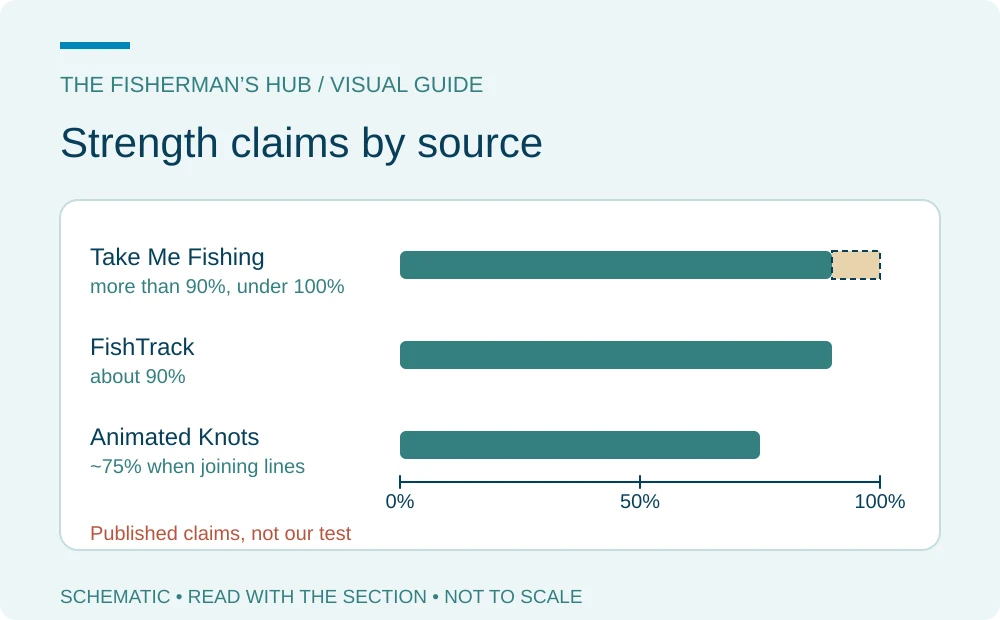
Take Me Fishing says the knot has been tested at less than 100% but more than 90%. The page does not say who did the testing.
FishTrack gives a holding strength of about 90%. For what it calls closer to 100% reliability, it suggests doubling over the tag ends of both lines before tying.
Animated Knots says testing arranged by Mack Martin showed the uni knot keeping 82% of line strength. When a uni is used to join two lines, it says a breaking strain around 75% is more likely.
Why the gap? The sources do not share one test. Take Me Fishing links strength to how close the two diameters are. FishTrack links it to how tightly the knots are snugged together. Animated Knots points to the way the line passes around itself in a line-to-line join.
Take Me Fishing calls the double uni one of the strongest line-connecting knots you can use when learning to fish, and says that strength makes it popular with saltwater anglers. Treat each percentage as a claim from that source, not a promise for your line.
Before you cast, pull the main line and leader apart with steady pressure. If the knot moves or slips, cut it off and tie it again.
Fix a double uni knot that looks wrong
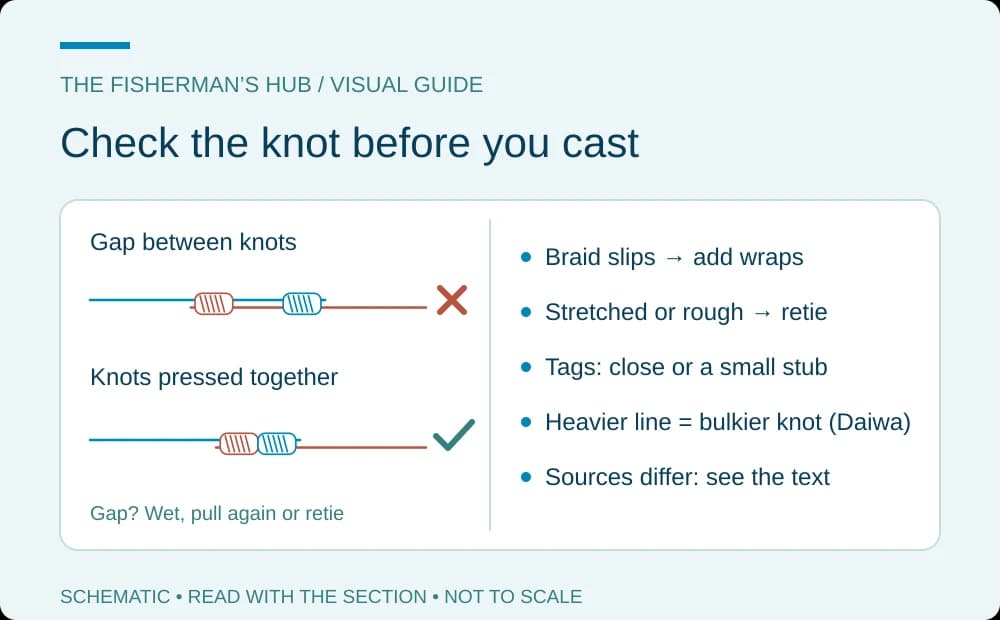
Check the knot before the first cast. If you see one of the problems below, cut the knot off and tie a new one on clean line.
- Source: FishTrack — how to tie the double uni-knot
- Source: Take Me Fishing — how to tie a double uni knot
- Source: Take Me Fishing — line-joining knots
- Source: Utah DWR — tips for tying better knots
- Source: Daiwa Australia — double uni tech tip
- Source: Orvis News — double uni knot
The two knots do not touch
A gap means the knots did not slide all the way together. FishTrack calls snugging them tightly against each other essential for maximum strength. Wet the line and pull the main line and leader apart again. If the knots will not move, retie.
The braid slips
If the braid side pulls loose, retie it with more wraps. Take Me Fishing doubles the braid wraps for strength, and FishTrack adds braid-side turns to prevent slippage. Use the higher braid count from the source you follow.
The line looks stretched or rough
Friction heat while tightening can stretch and weaken line, says the Utah Division of Wildlife Resources. Wetting the knot reduces that heat, and the agency also advises taking your time. Cut above the damaged part, then retie, wet the knot, and pull slowly.
How close should you trim the tag ends?
Sources disagree. Take Me Fishing and FishTrack say to trim the tag ends close to the knot. The Daiwa Australia presenter says not to cut them fully flush, because the knot may move a little, and leaves a short tag. Pick one approach and look at the knot again after trimming.
The knot catches in the rod guides
Rod guides are the rings along the rod that the line runs through. The expert quoted by Orvis says the double uni has a very small profile that passes smoothly through the guides. The Daiwa Australia presenter sees it differently: he typically uses the knot up to about 10 to 15 pounds, because it gets bulky in heavier line.